
Counter UAS - UNITAF Force Manual (FM)


Group

Counter UAS
This group is not in a published chapter and should not be relied upon.


FM/BG-1637 - Air defense warning conditions (ADW)

Air defence warning conditions (ADW) are used to posture units based on the assessed threat of aerial attack. They provide a scalable readiness framework aligned to current air threats.

ADW Levels:

  • ADW Red: Hostile aircraft or missile attack is imminent or in progress.
  • ADW Yellow: Hostile aircraft or missile attack is probable.
  • ADW White: Hostile aircraft or missile attack is improbable.

Subordinate leaders may increase the ADW level within their assigned area if local conditions warrant it. However, they may not reduce it below the general ADW established by higher command.

For example, if a platoon establishes ADW Yellow for the AO and a squad observes a hostile UAV loitering, the squad leader may elevate to ADW Red. Once the threat is mitigated, the squad may return to ADW Yellow, but may not reduce to ADW White unless the higher-level ADW changes.
FM/BS-1638 - Implement air defense warning conditions
  • Identify the current general ADW for the AO.
  • Interpret ADW levels:
    • Red: Attack imminent or in progress.
    • Yellow: Attack probable.
    • White: Attack improbable.
  • Assess local aerial threat indicators.
  • Elevate ADW for the assigned element when conditions warrant.
    • Do not reduce ADW below the general ADW set by higher command.
  • Communicate ADW changes clearly.
  • Return elevated ADW to the general level once the threat is mitigated.
FM/BG-1639 - CUAS weapon control status

Weapons Control Status (WCS) follows the framework established in FM/BG-335 - Understanding weapon control states. However, leaders may set a different WCS for UAS than the general WCS when the threat environment requires it.

For example, the general WCS may be Orange for conventional targets. If FPV kamikaze UAVs pose an immediate risk, a leader may establish UAS WCS Green to enable faster engagement of aerial threats.

Counter UAS WCS may be more permissive than the general WCS due to the differing risk balance:

  • A false negative (not engaging a hostile UAV) carries high operational risk.
  • A false positive generally carries lower cost than misidentifying a ground target.

This allows responsive UAS threat mitigation while maintaining overall fire control discipline.

FM/BS-1640 - Respond to UAS using the DIDE sequence
  • Detect
    • Maintain awareness for visual, thermal, or auditory indicators of UAS presence.
    • Announce detection clearly to the element.
  • Identify
    • Confirm the object as a UAV.
    • Determine type, behavior, and threat profile where possible.
  • Decide
    • Determine whether to engage based on:
      • Risk of drawing attention if not yet detected by the UAV.
      • Risk of friendly fire.
      • Risk posed to friendly forces.
      • Viability of engagement given available skill and equipment.
    • Determine how to engage (physical or non-physical method).
  • Engage
    • Employ the selected method:
      • Physical: Explosive munitions or small arms to destroy or damage the UAV.
      • Non-Physical: GPS or radio jamming to disrupt, disable, or control the UAV signal.
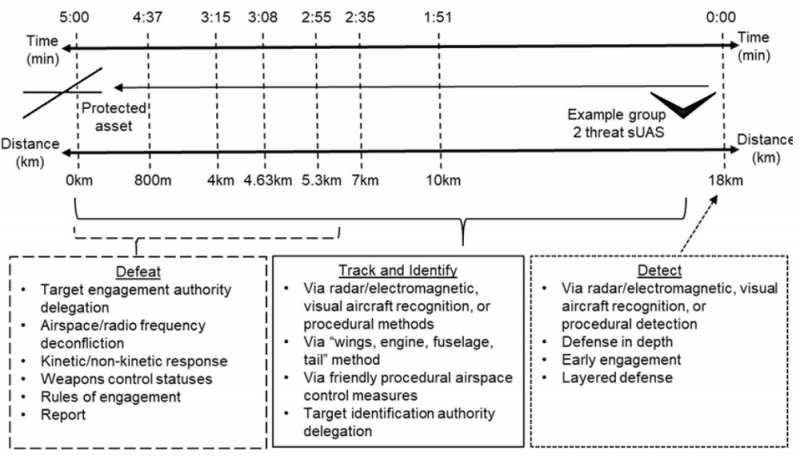
Timeline of Counter UAS actions

Above: Timeline of Counter UAS actions

FM/BG-1642 - Detecting UAS

Unmanned Aerial Systems (UAS) may be detected using methods similar to manned aircraft detection; however, small UAS (sUAS) may not appear on conventional air defence radar and can be difficult to detect due to their small size and low acoustic signature.

Air Guards are designated personnel responsible for monitoring for aerial threats near their unit and providing early warning. If equipped, Air Guards may also operate counter-UAS (C-UAS) equipment.

Visual Detection

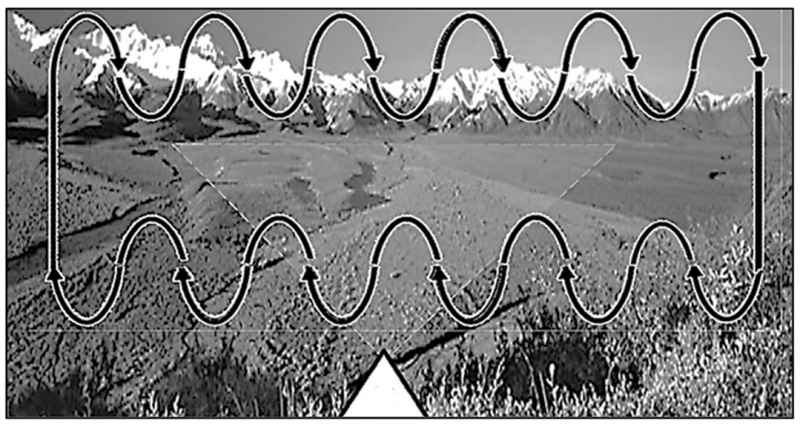
  • Conduct visual scanning using a vertical scan pattern.
  • Monitor approximately 20 degrees above and below the horizon.
  • Maintain continuous observation of the assigned sector.

Identification Methods

  • UAS may be operated by friendly or enemy forces. Two primary identification methods may be used:
    • Positive Identification: Uses IFF systems, visual recognition, or electronic support systems.
    • Procedural Identification: When positive identification is not possible, describe physical characteristics such as wingspan, rotor configuration, size, payload, and markings to assist leadership decision-making.
Visual representation of how to scan an area for UAS

Above: Visual representation of how to scan an area for UAS

FM/BS-1641 - Report UAS contacts
  • Upon detecting a UAS, immediately alert the element using FM/BS-40 - Give a structured Contact Report
  • Continue tracking the UAS until a decision is made to engage or not engage.
  • Include the following information when reporting:
    • Group (small or large) of the UAV
    • Visible payload
    • Direction of travel
  • When able, follow up the initial contact information using SALUTE reporting format:
    • Size: How big was the UAS?
    • Activity: What was the UAS doing?
    • Location: Where was the UAS?
    • Unit/Uniform: Was there any identifying marks?
    • Time Observed: When did you see it?
    • Equipment: Has the UAS got any visible weapons/payload/sensors?
FM/BG-1643 - UAS deconfliction and identification

With Weapons Control Status (WCS) for UAS being generally more permissive than for conventional contacts due to the higher risk posed by false negatives compared to false positives. The objective is to prevent both friendly fire incidents and undetected hostile UAS through positive identification (PID) and airspace deconfliction.

Fixed-wing UAS are often easier to identify due to larger profiles, markings, or insignia. Small UAS (sUAS) may be difficult to identify due to size, speed, range, and use by multiple forces without clear markings.

Upon detecting an unknown UAS:

  • FM/BS-1641 - Report UAS contacts immediately up the chain of command.
  • Maintain visual or sensor tracking.
  • Treat the contact as potentially hostile until identification is confirmed.
  • Prepare defensive or engagement actions if authorized.

To reduce misidentification risk, UAS operators should proactively announce their presence when operating near friendly elements. Clear communication reduces friendly fire risk and improves airspace awareness.

This page generated 1.09MB in 0.1388 seconds.