
Reacting to UAVs - UNITAF Force Manual (FM)


Group

Reacting to UAVs
This group is not in a published chapter and should not be relied upon.


FM/BG-1655 - Survivability framework against RPS

The survivability framework provides a structured approach to countering RPS threats by layering responses:

  • Preventative Reactions focus on avoiding detection and targeting before an immediate threat is identified.
  • Defensive Reactions focus on reducing the likelihood or impact of a strike once a threat exists.
  • Offensive Reactions involve actively disrupting or destroying the RPS platform when feasible.

Preventative measures should be the default posture. Defensive and offensive reactions are employed based on threat confirmation, capability, and leadership assessment.
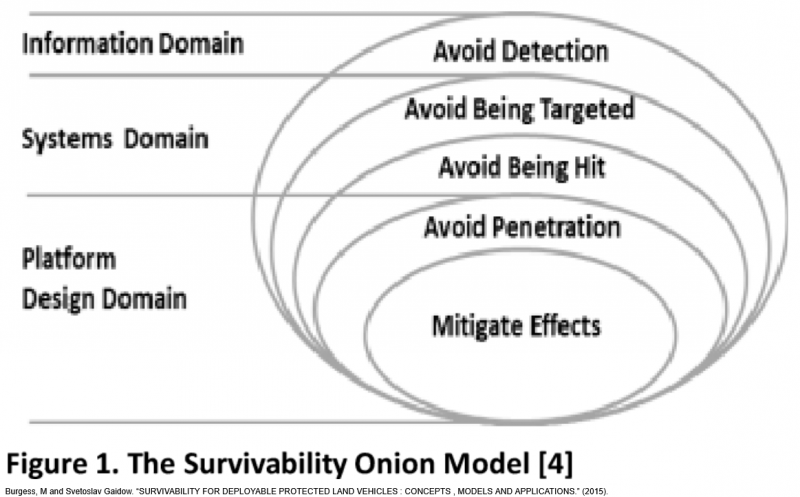
The survivability onion

Above: The survivability onion

FM/BG-1656 - Preventative reactions to UAV threats

UAV detection is difficult to avoid. Units should assume they are under observation at all times.

To reduce detection, identification, and tracking:

  • Use camouflage, concealment, and terrain masking.
  • Minimize movement in exposed areas.
  • Avoid skyline positioning and predictable patterns.
  • Reduce light, noise, and thermal signature where possible.

Preventative measures aim to delay or complicate enemy targeting decisions.

FM/BG-1657 - Defensive reactions to UAV threats

When a UAV threat is identified, defensive measures may supersede stealth depending on the situation.

Leaders must balance low observability with passive defence systems such as jammers.

Common defensive measures include:

Dispersion

  • Maintain spacing between personnel and vehicles.
  • Reduce multi-target strike effectiveness.

Displacement

  • Relocate if actively targeted or used as ISR reference.
  • Balance movement against loss of fortified or mission-critical positions.

Fortification

  • Use trenches, sandbags, and covered positions to reduce fragmentation effects.
  • Avoid single-entry choke points where possible.

Netting

  • Employ overhead protection where available.
  • Understand its limitations against certain munitions.
FM/BS-1658 - Employ electronic counter-UAS measures
  • Identify active UAV signal frequencies using spectrum tools.
  • Align and maintain directional jamming.
  • Sustain jamming until signal disruption is achieved.
  • Coordinate jamming with unit movement and concealment.
FM/BG-1659 - Kinetic counter-UAS engagement

Offensive reactions involve disrupting or destroying a hostile UAV when stealth or defensive measures are insufficient.

Engage larger UAVs with dedicated air defense systems where available. Use electronic countermeasures when equipped.

Small arms engagement of small UAVs is a last resort. If required:

  • Coordinate volume of fire.
  • Use tracers to adjust.
  • Maintain awareness of ground threats.

Engagement must be balanced against mission priorities, ammunition use, and exposure risk.

This page generated 1.06MB in 0.1139 seconds.