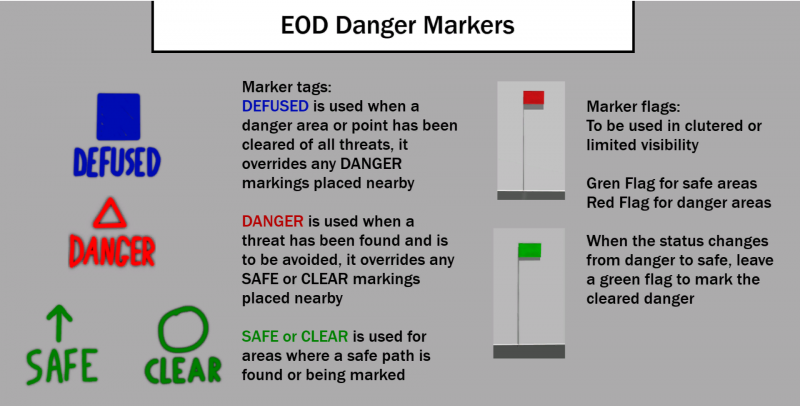
When encountering explosive hazards, clear and consistent marking is essential to protect follow-on elements. Engineers are responsible for communicating both danger areas and verified safe paths.
Two primary marking tools are available: EOD stencils and flag markers.
EOD Stencils
Stencils use text and standardized shapes for rapid recognition. Three color-coded statuses apply:
- DEFUSED: Indicates the area or device has been cleared of all threats. Overrides any nearby DANGER markings.
- DANGER: Indicates a confirmed threat. Overrides any SAFE or CLEAR markings in the vicinity.
- SAFE / CLEAR: Indicates a verified safe path or cleared area.
Markings should be placed clearly and unambiguously to prevent conflicting signals.
Flag Markers
When ground tags are not visible (e.g., tall grass, debris, uneven terrain), use flag markers instead:
- Red flags: Mark confirmed danger areas.
- Green flags: Mark safe lanes or cleared areas.
If a danger area marked by a red flag is later cleared, replace or supplement it with a green flag to ensure clarity for follow-on elements.
Placement Standard
Markers must be visible from a distance. Safe lanes should be marked at regular intervals, with each marker visible from the next to create a continuous path. Danger markers should be positioned at eye level when ground visibility is limited to ensure they are not overlooked.
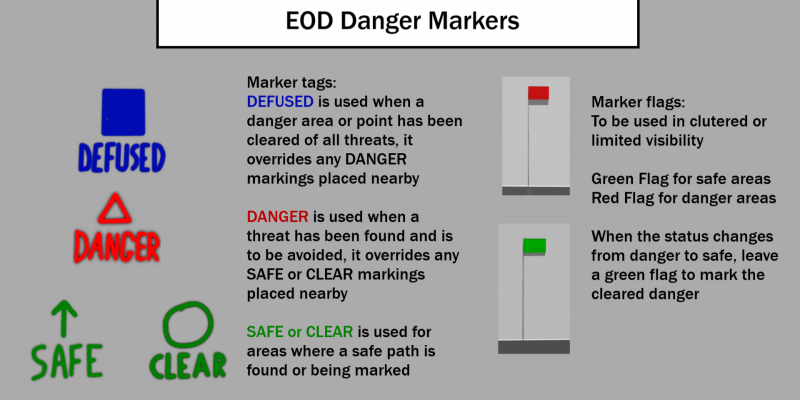
Above: Markings available with the EOD Stencil
added image