
FM/BG-1526.V1.01 - Boundaries and attack lanes
What Boundaries and Lanes Are
- Boundaries are control measures that separate adjacent units’ areas of responsibility during movement or assault.
- Lanes are assigned corridors within which a unit advances or moves.
They are used to:
- Prevent friendly collisions or overlapping fields of fire
- Maintain alignment and direction of advance
- Organize multiple elements moving along the same axis
Boundaries define limits laterally, while lanes define the path forward.
Best Practices
- Anchor to Terrain
- Use streets, ridgelines, rivers, or other clear features to define lateral limits.
- Lanes should follow easily navigable routes (roads, alleys, or trails).
- Keep Dimensions Manageable
- Boundaries: wide enough for safety but narrow enough to prevent drift.
- Lanes: allow movement without congestion, obstacles, or crossfire.
- Assign Responsibility
- Each element knows which lane or side of the boundary they occupy.
- Overlaps only at designated coordination points.
- Coordinate Fires and Movement
- Use boundaries to prevent friendly fire.
- Ensure support elements respect the lateral limits.
Naming and Communication
Name boundaries and lanes clearly (e.g., Lane 1, Lane 2; Boundary RED, Boundary BLUE).
Report positions and movements using the assigned lane/boundary:
- “1-1 advancing Lane 2.”
- “Squad Bravo holding Boundary RED.”
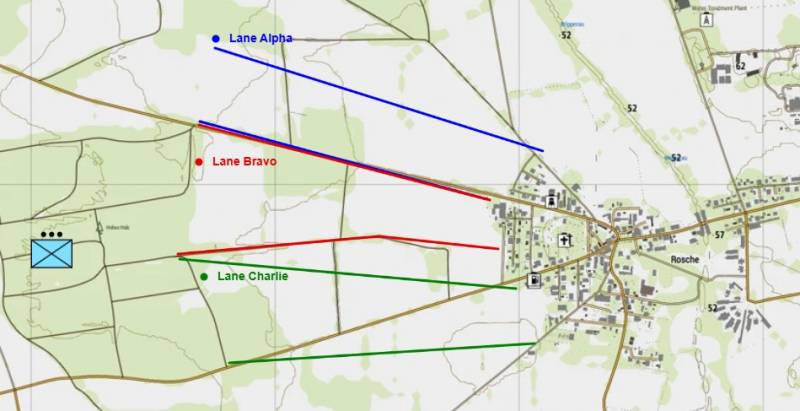
Above: Example attack lanes for a town objective.
Last major change:
Initial Version

