The Combat Leadership Handbook - UNITAF Force Manual (FM)


The Combat Leadership Handbook
Combat Leadership focuses on the front-line roles of fireteam and squad leading during direct combat. These leaders are responsible for guiding tactical units, making decisive decisions, and ensuring mission success in intense and challenging environments.


FM/G92 - Training Teams

FM/BG-456 - Introduction to Training Teams

The 'Training Team' is a specialised group within the unit responsible for overseeing and managing the evaluation and improvement of a specific combat area. Comprising appointed individuals including Chief Instructors, Staff Instructors, Training Instructors, and Observers, the team operates under the guidance of Training Command. Each member has distinct roles and responsibilities, ranging from providing subject matter expertise to facilitating training sessions and assessing skill levels. Together, they ensure that training standards are met, skills are effectively taught and practiced, and feedback is provided to enhance individual and unit proficiency in specific combat areas.
FM/BP-457 - Chief Instructors
  • Designated member of the unit serving as a subject matter expert in a specific combat area
  • Minimum of 1 and maximum of 2 may be assigned to any combat area
  • Acts as a senior advisor to unit command, providing guidance on potential changes and advising on ongoing discussions
  • Active participant in training, application, and observation of combat area skills
  • Holds the highest weighted opinion among all other roles
  • Accountable to both the Staff Instructor and Training Command
  • Appointment made at the discretion of Training Command
FM/BP-458 - Staff Instructors
  • Member of J7 Staff responsible for overseeing a specific combat area, its training and training team
  • Minimum of 1 and maximum of 2 per skill card; each staff member can oversee up to 4 skill cards in total
  • Serves as the primary point of contact in the combat area for Training Command, Chief Instructors, Instructors, Observers, and the wider unit
  • Ensures adequate training and practices are conducted through the training team
  • Appoints and removes Training Instructors and Observers as needed, based on advice from Chief Instructors and in collaboration with Training Command
  • Collaborates with Policy staff to implement changes and distribute them upon publication by Unit Command
  • Holds the second highest weighted opinion among the roles involved
  • Actively participates in training, application, and observation of combat area skills
  • Accountable to Training Command and appointed at their discretion
FM/BP-459 - Training Instructors
  • Unit member appointed as a Training Instructor in a specific combat area, having transitioned from the role of Observer
  • Recognized by the training team as a well-rounded individual capable of effectively teaching relevant combat area skills in group settings
  • Possesses a solid understanding of the combat area skills
  • Holds the third highest weighted opinion among the roles involved
  • Limited to a maximum of 6 Training Instructors per combat area
  • Actively engages in training, application, and observation of combat area skills
  • Accountable to both the Staff Instructor and Chief Instructors
FM/BP-460 - Observers
  • A member of the unit who is appointed as an Observer in a specific combat area, who in the eyes of the training team is trusted to assess others in a non-teaching capacity in the combat areas skills.
  • Typically a starting role on route to Training Instructor.
  • Holds the lowest weighted opinion.
  • Maximum of 8 per combat area
  • Active in the training, application and observation of combat area skills.
  • Accountable to the Training Instructors and Chief Instructors.

FM/G266 - Combat Leadership Experience

FM/BG-1236 - Temporary Experience Requirements Explained

Your role access is determined by your skills, experience with those skills, and the specific roles that utilize them. With over 100 roles in UNITAF, creating detailed skill breakdowns for every role is a substantial undertaking that cannot be completed overnight. 

Estimated Role Cards

To ensure the entire unit can transition to the new system immediately, some roles are tagged as **"Estimated"**. These roles use a transitional approach:

  • Temporary skill blocks simulate role-specific experience
  • Estimated access levels are calculated based on these placeholder blocks
  • Similar to LTS functionality but with improved accuracy and fewer limitations

Current State: Estimated roles provide functional access levels that closely mirror the previous LTS system while addressing many of its shortcomings. As development progresses, estimated role cards will be upgraded to the full FTS3 standard with detailed, role-specific skill requirements.

Important Note: When roles transition from "Estimated" to "Verified" status, your access level may change (either increase or decrease) as the requirements become more precise and role-specific.

This approach allows UNITAF to:

  • Maintain operations during the transition period
  • Provide immediate access to the improved FTS3 system
  • Ensure continuity while detailed role cards are developed
  • Gradually improve role accuracy over time

The estimated system serves as a bridge, ensuring no disruption to unit operations while we build toward the comprehensive FTS3 vision.

FM/BS-1227 - Experience in Combat Leadership Roles

This is a temporary skill block, the skill block is being used to accumulate SP for time spent in Combat Leadership roles until it's role card is completed.

FM/BS-1224 - Experience as Acting Fireteam Leader

This is a temporary skill block, the skill block is being used to accumulate SP for time spent as Junior Team Leader until it's role card is completed.

FM/BS-1225 - Experience as Fireteam Leader

This is a temporary skill block, the skill block is being used to accumulate SP for time spent as Fireteam Leader until it's role card is completed.

FM/BS-1226 - Experience as Squad Leader

This is a temporary skill block, the skill block is being used to accumulate SP for time spent as Squad Leader until it's role card is completed.

FM/BS-1233 - Experience as Squad Commander

This is a temporary skill block, the skill block is being used to accumulate SP for time spent as Squad Commander until it's role card is completed.

FM/G328 - Terrain features

FM/BS-1483 - Estimate travel time for dismounts

Measure straight-line distance using the map scale and convert it with grid tools.

  • Use ~10 km/h as baseline  speed on flat, open terrain.
  • Adjust for terrain:
    •  Roads / open ground: maintain ~10 km/h.
    •  Hills, forests, etc reduce speed by: -30–50% speed.
  • Add time for obstacles (fences, rivers, buildings) requiring detours or crossings.
  • Adjust for unit load and type, as weight and role affect movement speed.
  • Compute travel time: distance ÷ adjusted speed.
FM/BS-1482 - Perform line-of-sight (LOS) checks on a map

Perform LOS checks to determine visibility between observer and target.

  1. Identify observer and target positions.
  2. Compare elevations via contour lines or shading.
  3. Assess terrain or structures blocking visibility.
  4. Determine visible portion of the target area.
  5. Annotate arcs, dead ground, and blocked areas on the map. 
FM/BS-1481 - Plot movement routes using terrain analysis
  • Choose routes providing cover and concealment.
  • Avoid known or suspected danger areas and obstacles.
  • Consider terrain slope, vegetation, and obstacles on movement speed and safety. 
FM/BS-1480 - Identify natural and man-made obstacles
  • Detect rivers, cliffs, fences, walls, and urban structures.
  • Assess obstacle impact on infantry, vehicles, and logistics movement.
FM/BS-1479 - Identify dead ground and observation lines
  • Locate concealed areas hidden from enemy observation (dead ground).
  • Identify optimal observation points for overwatch and surveillance.
  • Evaluate exposure risks and blind spots on terrain. 
FM/BS-1478 - Recognise geographic features on a map
  • Identify hills, valleys, ridgelines, depressions, rivers, and forests.
  • Assess their impact on observation, cover, and movement.
  • Distinguish natural obstacles from man-made features. 
FM/BG-1477 - Understanding terrain features

Understanding terrain is essential for tactical movement. Terrain influences movement, observation, cover, and concealment.

  • High ground provides superior observation and firing positions; ideal for overwatch, observation posts (OPs), and fire support.
  • Low ground offers concealment but limits visibility and increases risk from enfilade fire.
  • Ridges and hills offer a balance of cover and visibility; reverse slopes protect from direct fire.
  • Valleys and depressions allow concealed movement but increase ambush risk; difficult to observe externally.
  • Water features may restrict movement; bridges and fords become critical control points.
  • Forests and woodblocks provide concealment and cover; facilitate stealth movement.
  • Open terrain increases exposure but allows rapid movement if supported by fire or smoke. 

FM/G329 - Map symbology

FM/BG-1484 - Map points of interest (POIs)

POIs are reference markers essential for navigation, observation, and reporting. Accurate recording using grid references is critical.

  • Tactical POIs: bunkers, trenches, OPs, strongpoints, checkpoints.
  • Strategic POIs: objectives, headquarters (HQs), communications relays, logistics hubs.
  • Natural POIs: distinctive landmarks aiding navigation (e.g., lone tree, unique rock).
  • Civilian POIs: villages, compounds, areas with civilian activity. 
FM/BS-1485 - Recognise POI symbols on a map
  • Interpret tactical, strategic, natural, and civilian POI markings by referring to the OPORD.
  • Correlate POIs with current mission objectives. 
Image
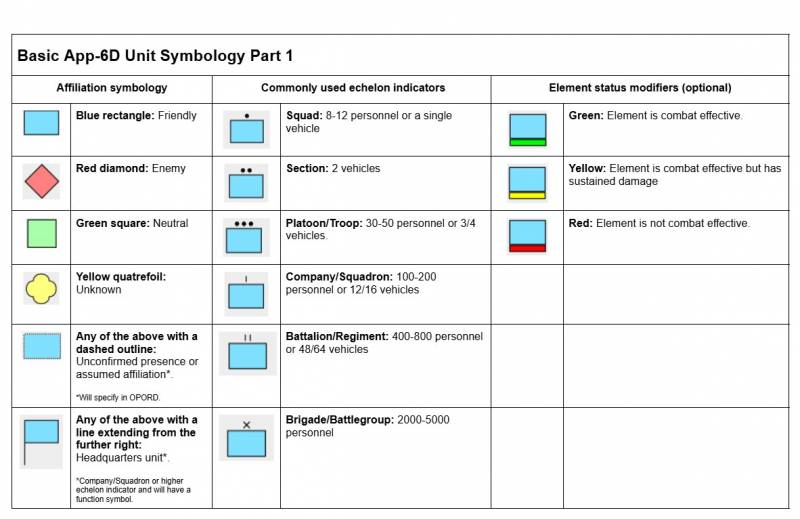
FM/BI-1513 - APP-06 (MIL-STD-2525D) symbology part 1
Image
A guide of basic NATO-standard APP-06 symbols used to mark units, equipment, and tactical functions on maps.

Above: A guide of basic NATO-standard APP-06 symbols used to mark units, equipment, and tactical functions on maps.

Image
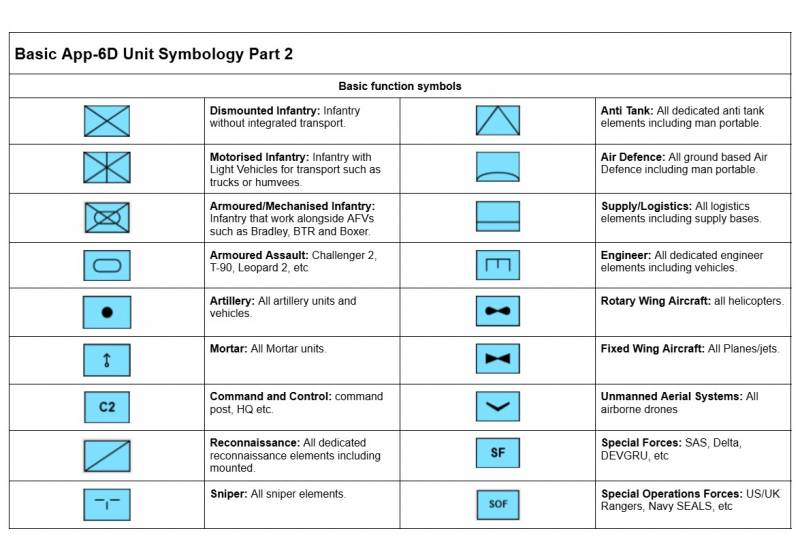
FM/BI-1514 - APP-06 (MIL-STD-2525D) symbology part 2
Image
A guide of basic NATO-standard APP-06 symbols used to mark units, equipment, and tactical functions on maps.

Above: A guide of basic NATO-standard APP-06 symbols used to mark units, equipment, and tactical functions on maps.

FM/BS-1487 - Recognise basic APP-06 symbols on a map
  • Identify unit size, type, and function from symbols.
  • Distinguish friendly, enemy, neutral, and unknown forces by colour.
  • Understand status indicators such as readiness or engagement. 
FM/BS-1488 - Apply the correct APP-06 basic symbols
  • Select appropriate symbols for unit type and size.
  • Use correct colour coding for affiliation.
  • Place symbols in correct positions and maintain clarity on overlays and briefs. 

FM/G334 - Control measures

FM/BG-1489 - What are control measures?

Control measures are tools used to organize, coordinate, and manage forces during an operation.

They help commanders and units:

  • Maintain alignment and spacing
  • Synchronize movement, fires, and support
  • Define boundaries, objectives, and responsibilities
  • Prevent fratricide or confusion
FM/BG-1524 - Sectors

What a Sector Is

A sector is a designated area of responsibility within a town or urban objective, assigned to a squad or team for clearance.

Sectors help:

  • Divide complex urban areas into manageable portions
  • Maintain control and accountability
  • Coordinate movement, fires, and support

Sectors should be sensible, clear, and easy to reference.

Best Practices

  • Keep Sectors Manageable
    • Each sector should be sized so the assigned team can clear it efficiently without overextension.
    • Avoid overly large or irregular sectors that complicate coordination.
  • Use a Simple Naming System
    • Standardize names using a grid-like system: A1, A2, B1, B2, etc.
    • Rows and columns help adjacent units easily identify boundaries.
    • Avoid complicated or inconsistent names.
  • Align Sectors with Terrain
    • Use streets, canals, ridgelines, or major buildings to define borders.
    • Physical features make sectors easier to recognize during movement and coordination.
  • Assign Responsibility Clearly
    • Each sector must have an assigned element responsible for clearing and reporting progress.
    • Ensure overlapping coverage at boundaries is minimized to prevent gaps or duplication.
  • Coordinate Adjacent Sectors
    • Establish coordination points at intersections or key terrain features.
    • Adjacent teams should maintain visual or radio contact when possible.

Communication

Report progress by sector:

  • “1-1 cleared Sector A2.”
  • “Team Bravo securing Sector B1.”

Use sector names for directing support, fires, or follow-on movement.

Example sectors for a town objective

Above: Example sectors for a town objective

FM/BG-1525 - Objective box

What an Objective Box Is

An Objective Box (OB) is a clearly defined area representing the full extent of an objective, such as an entire town, village, or urban complex.

  • It defines the boundaries of the objective.
  • It ensures all units understand the area requiring clearance.
  • Within the OB, the area can be subdivided into smaller sectors for individual squads or teams.

Best Practices

  • Anchor to Terrain
    • Use roads, rivers, canals, ridgelines, or urban landmarks to mark the OB’s corners.
    • Clearly recognizable features make coordination and orientation easier.
  • Size Appropriately
    • Cover the entire objective to prevent missed areas.
    • Avoid making it so large that it becomes unmanageable for assigned forces.
  • Subdivide into Sectors
  • Coordinate Support
    • Use the OB as a reference for fire support, CAS, and logistics.
    • Synchronized actions are easier when all elements reference the same boundaries.

Communication

Reference the OB in orders and reports:

  • “1st Platoon clearing Objective Box Alpha, Sector A2.”
  • “All elements secure Objective Box Bravo as per orders.”
Example objective box for a town objective

Above: Example objective box for a town objective

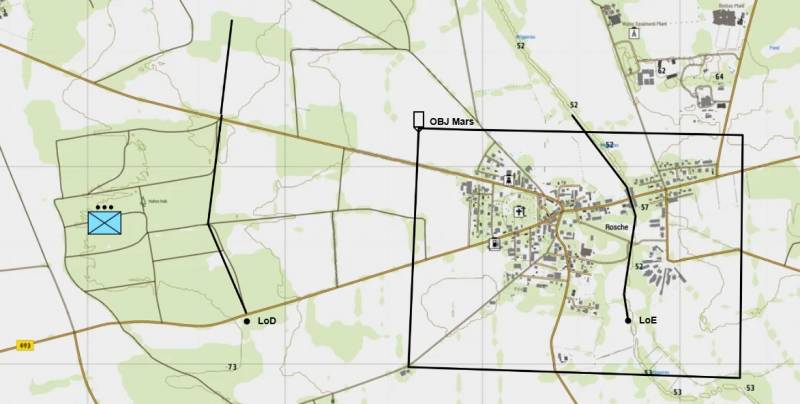
FM/BG-1522 - Line of departure (LoD)

What a Line of Departure Is

  • A Line of Departure (LoD) is the designated line where an assault or advance begins.
  • It signals the transition from preparation or assembly to movement or attack.

The LoD is a control measure, not an objective. Crossing it initiates the operation.

When to Use

Most effective in:

  • Deliberate assaults
  • Platoon- or company-level attacks
  • Coordinated multi-element movements

Generally unnecessary for small patrols or spontaneous actions.

Best Practices

  • Anchor to recognizable terrain (road, ridgeline, tree line, or urban feature).
  • Clearly define who crosses first and in what order.
  • Ensure all support (fires, logistics, follow-on elements) is prepared before crossing.
  • Tie crossing to a trigger (e.g., H-Hour or command order).

Communication

Keep reports concise:

  • “1-1 crossing LoD.”
  • “All elements set on LoD.”
Example Line of departure location.

Above: Example Line of departure location.

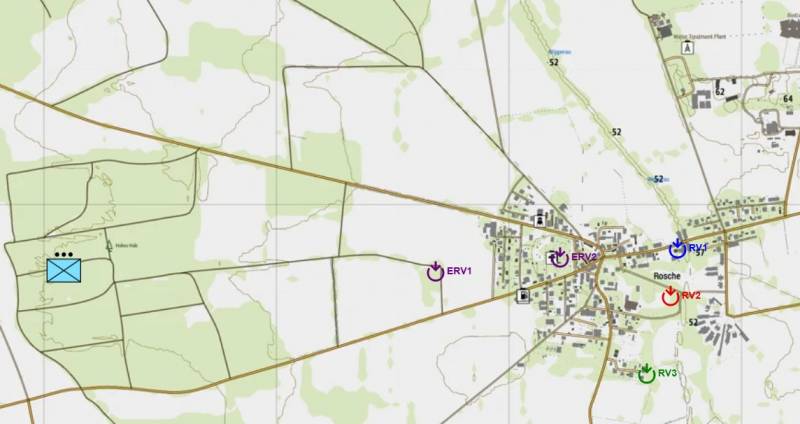
FM/BG-1523 - Rendezvous (RVs) and Emergency Rendezvous (ERVs)

Definitions

  • RV (Rendezvous):
    • A planned link-up point where elements meet during movement or prior to execution.
  • ERV (Emergency Rendezvous):
    • A pre-designated rally point used if elements become separated, break contact, or lose communication.
  • FRV (Final Rendezvous):
    • The last designated assembly point immediately prior to initiating an attack. It is used to consolidate all assault elements, confirm final readiness, and complete last-minute coordination before crossing the line of departure or beginning the final assault phase.

When to Use

  • RVs can be used in all operations.
  • ERVs are used when elements become separated or C2 is degraded.
  • FRVs are used specifically during offensive operations as the final consolidation point before execution of an attack.

Best Practices

  • Anchor to recognizable terrain.
    • Use intersections, buildings, terrain features, or distinct map references.
  • Keep locations practical.
    • Avoid exposed or tactically unsound areas.
  • Assign purpose clearly.
    • RV: Planned link-up during movement
    • ERV: Emergency regroup point
    • FRV: Final consolidation prior to assault
  • Limit quantity.
    • Over-designating rendezvous points causes confusion.

Execution Considerations

  • At an RV:
    • Confirm accountability
    • Conduct quick coordination
    • Adjust plan if required
    • Conduct medical and/or resupply
  • At an ERV:
    • Establish security
    • Rebuild command and control
    • Await further direction
  • At an FRV:
    • Conduct final accountability of assault elements
    • Confirm weapons, ammunition, and readiness status
    • Rehearse or confirm assault plan and timing
    • Synchronise final fire support or enabling assets
    • Issue final go/no-go confirmation before execution

Communication

Use concise reporting:

  • “1-1 set at RV.”
  • “All elements at FRV.”
  • “Breaking contact to ERV.”
Example RVs for town objective.

Above: Example RVs for town objective.

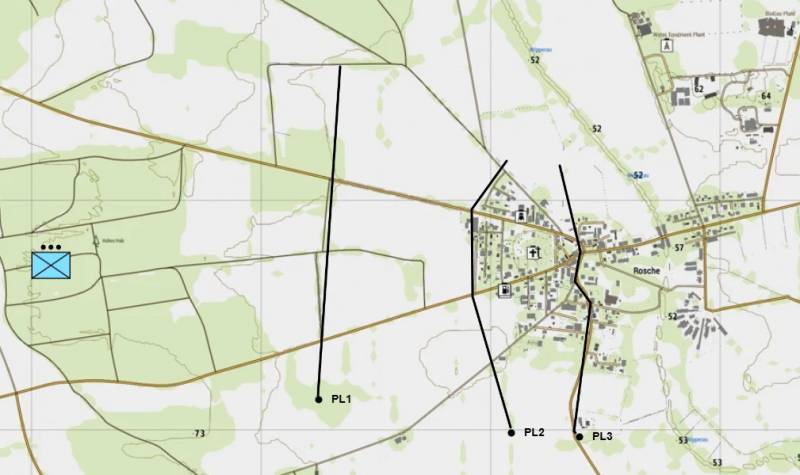
FM/BG-1520 - Phase lines (PLs)

What a Phase Line Is

A Phase Line (PL) (sometimes known as Report Line) is a named control measure drawn across the area of operations to assist with coordination and synchronization.

PLs are used to regulate:

  • Tempo of maneuver
  • Fire support shift/lift
  • Movement of follow-on elements
  • Engagement or fallback triggers

A Phase Line is not an objective or a mandatory halt line unless specifically stated.

Planning test:
If crossing the PL does not trigger an action or report, it likely does not need to exist.

When to Use Phase Lines

Most effective in deliberate, structured operations such as:

  • Platoon- or company-level assaults
  • Mechanized or multi-element manoeuvre
  • Fire support integration
  • Layered defensive plans

They are generally unnecessary for small, fluid, squad-only actions.

Best Practices

  • Anchor to terrain: 
    • Use recognizable features (roads, ridgelines, rivers, major streets).
  • Limit quantity:
    • Use only what is required to control tempo or fires.
    • Too many PLs create clutter and unnecessary reporting.
  • Tie to action:
    • Crossing a PL should trigger something:
      • Shift/lift fires
      • Commit follow-on elements
      • Authorize engagement
      • Execute fallback
      • a halt to maintain cohesion with other elements
  • Align to the axis of advance:
    • Draw PLs perpendicular to movement to clearly show progression.

Common Applications

  • Offense:
    • Control tempo and fire shifts during assaults.
  • Movement:
    • Define bounds during controlled advances.
  • Fire Support:
    • Establish fire limits or lift points.
  • Defence:
    • Set engagement triggers or fallback criteria.

Naming and Communication

Use one consistent naming convention (e.g., ALPHA / BRAVO / CHARLIE, GOLD / SILVER / BRONZE, 1 / 2 / 3).

Keep reports concise:

  • “1-1 at PL ALPHA.”
  • “2-1 crossing PL BRAVO.”
  • “All elements set at PL CHARLIE.”
Example phase lines for a town objective.

Above: Example phase lines for a town objective.

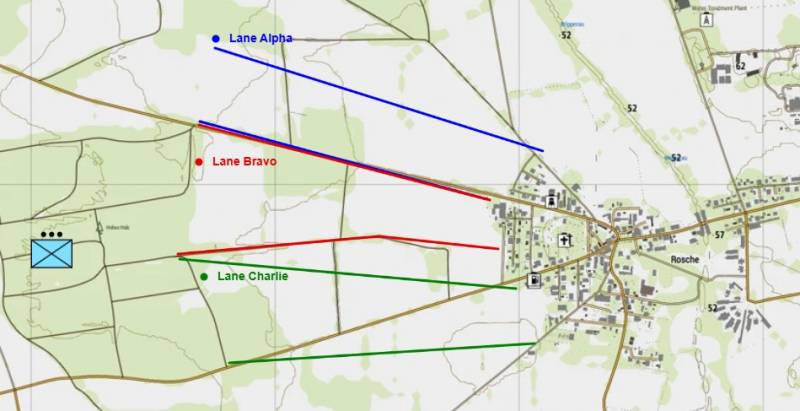
FM/BG-1526 - Boundaries and attack lanes

What Boundaries and Lanes Are

  • Boundaries are control measures that separate adjacent units’ areas of responsibility during movement or assault.
  • Lanes are assigned corridors within which a unit advances or moves.

They are used to:

  • Prevent friendly collisions or overlapping fields of fire
  • Maintain alignment and direction of advance
  • Organize multiple elements moving along the same axis

Boundaries define limits laterally, while lanes define the path forward.

Best Practices

  • Anchor to Terrain
    • Use streets, ridgelines, rivers, or other clear features to define lateral limits.
    • Lanes should follow easily navigable routes (roads, alleys, or trails).
  • Keep Dimensions Manageable
    • Boundaries: wide enough for safety but narrow enough to prevent drift.
    • Lanes: allow movement without congestion, obstacles, or crossfire.
  • Assign Responsibility
    • Each element knows which lane or side of the boundary they occupy.
    • Overlaps only at designated coordination points.
  • Coordinate Fires and Movement
    • Use boundaries to prevent friendly fire.
    • Ensure support elements respect the lateral limits.

Naming and Communication

Name boundaries and lanes clearly (e.g., Lane 1, Lane 2; Boundary RED, Boundary BLUE).

Report positions and movements using the assigned lane/boundary:

  • “1-1 advancing Lane 2.”
  • “Squad Bravo holding Boundary RED.”
Example attack lanes for a town objective.

Above: Example attack lanes for a town objective.

FM/BG-1521 - Limit of exploitation (LoE)

What a Limit of Exploitation Is

A Limit of Exploitation (LoE) defines the maximum depth an attacking element may advance.

It is used to prevent:

  • Overextension
  • Loss of mutual support
  • Collision with adjacent units
  • Advancing beyond sustainment

An LoE is a control boundary, not an objective.

When to Use

Most effective in:

  • Deliberate assaults
  • Mechanized breakthroughs
  • Multi-element attacks
  • Operations with adjacent units

Generally unnecessary for small, short-duration missions.

Best Practices

  • Anchor to clear terrain when possible (road, river, ridgeline).
  • State what happens at the LoE (halt, hold, or await orders).
  • Require authorization before advancing beyond it.

The LoE should control depth and maintain cohesion without slowing momentum.

Communication

Keep reporting simple:

  • “1-1 at LoE.”
  • “Objective secure, holding at LoE.”

Movement beyond the LoE should be deliberate and directed.

Example Limit of Exploitation for a town objective.

Above: Example Limit of Exploitation for a town objective.

Image
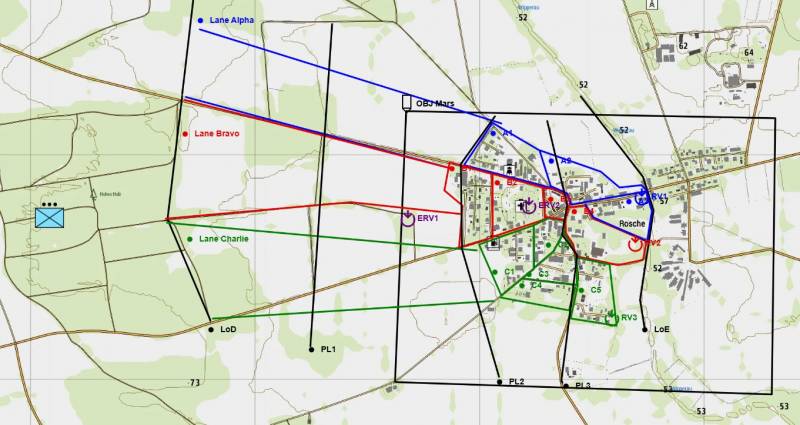
FM/BI-1527 - Worked example of control measures
Image
A full worked example of control measures for a town objective.

Above: A full worked example of control measures for a town objective.

FM/BS-1490 - Interpret friendly control measures
  • Identify phase lines, boundaries, sectors, and objective boxes on mission maps.
  • Plan fire team or squad movement to remain within assigned sectors, lanes, and limits of exploitation.
  • Deconflict actions to prevent overlap, friendly collisions, or breaches of assigned boundaries.
  • Report positions and status at designated rendezvous points (RV, FRV, ERV) or sector boundaries.

FM/G136 - Infantry elements

FM/BG-712 - Combat buddy teams

Every infantryman operates within a buddy team, ensuring that everyone always has someone to rely on in combat. This approach provides mutual protection and improves combat effectiveness. Standardised in the platoon, buddy teams can be adjusted by fireteam leads based on the situation. The specific composition is indicated on the ORBAT.

Responsibilities

  • Always stay close to your buddy, within verbal range (shouting/talking distance) at all times.
  • Keep your buddy informed of your movements and actions to maintain situational awareness.
  • Cover your buddy’s movements, opposing sectors, and vulnerable moments.
  • If your buddy goes down, quickly assess the situation, provide cover, and extract them to safety.
  • Maintain mutual accountability, losing track of your buddy is as much your responsibility as theirs.
FM/BG-323 - Infantry fireteams

Each Fireteam consists of four to six players: a leader and 3 to 5 subordinates. New players will end up acting as a rifleman in one of the Fireteams. Riflemen will be under the charge of a more experienced player, acting as the Fireteam Leader (FTL). They in turn, will be under the command of a Squad Leader who leads the two Fireteams that make up each squad. Likewise, the Squad Leader will be under the command of the Platoon Commander, who commands the two or three squads that form the platoon. They are led by the Company Commander, who directs the movements of the platoons in their Company.

A typical fireteam in the field

Above: A typical fireteam in the field

FM/BG-1298 - Companies

A company is composed of two to three platoons and a Company Command Element, forming the largest cohesive player-controlled formation. The company executes the overall mission assigned by higher command, coordinating all subordinate platoons and attached support assets such as logistics, air, and artillery. The Company Commander (CoyCo) provides strategic direction and overall control.

Responsibilities

  • Coordinate the movement and actions of all platoons to ensure unity of effort.
  • Manage and allocate supporting assets in line with mission priorities.
  • Maintain situational awareness of friendly platoon positions, combat effectiveness, and logistics status.
  • Communicate regularly with higher command, relaying progress and requesting support as required.
  • Ensure platoon commanders understand the plan’s purpose as well as its details, enabling initiative under changing conditions.
  • Maintain flexibility to reinforce, recover casualties, or shift the main effort as the battle evolves.
  • Conduct post-mission evaluation to identify lessons learned and improve future performance.
FM/BG-1297 - Platoons

A standard platoon is composed of three rifle squads and a four-man Command Element, known as Platoon Headquarters (PltHQ). The PltHQ includes the Platoon Commander (PltCo), Platoon Sergeant (PltSgt), Platoon Medic (PltMed), and a Rifleman who provides security for the element.

Platoons are the core tactical formation on the battlefield, linking company-level direction to squad-level execution. The Platoon Commander leads the platoon in accordance with the Company Commander’s intent, ensuring that all subordinate squads act in concert toward a unified mission objective.

Responsibilities

  • Brief squad leaders on the Commander’s intent and ensure full understanding of the mission and desired end state.
  • Maintain control and coordination of all attached squads and supporting elements.
  • Position command and support elements effectively to maintain visibility and control of the battle.
  • Keep squads within mutually supporting distance, avoiding fragmentation of combat power.
  • Delegate tasks and share workload with the Platoon Sergeant.
  • Avoid micromanagement; empower Squad Leaders to adapt the fight as required.
  • Gather and maintain awareness of platoon ACE (Ammo, Casualties, Equipment) status and report to company command as needed.
  • Reorganise or reinforce squads when casualties or mission conditions require.
FM/BG-1296 - Infantry squads

A rifle squad is a formidable unit built around flexibility and firepower. Each squad typically consists of two Fireteams and a Squad Leader element, usually totalling 14 personnel. The Squad Leader commands two Fireteam Leaders and their teams, supported by a Squad Medic who provides immediate medical care and acts as the second member of the squad lead element.

Squads form the primary fighting unit of a platoon. They execute the Platoon Commander’s intent through aggressive manoeuvre, disciplined communication, and mutual support between Fireteams.

Responsibilities

  • Execute the Platoon Commander’s intent through coordinated Fireteam manoeuvre and fire.
  • Maintain constant situational awareness of friendly and enemy positions.
  • Keep both Fireteams within mutual support range at all times.
  • Communicate regularly with other squad leaders and up to the platoon command.
  • Ensure all squad members understand the current plan, ROE, and formations.
  • Manage casualties within the squad and coordinate with the Platoon Medic when required.
  • Reorganise and redistribute personnel or equipment as casualties occur.
  • Avoid changing the squad’s structure without approval from the field leader.

FM/G278 - Callsigns

FM/BG-1136 - Callsigns

A callsign is the identifier that is used to address another unit over radio. Every unit down to the fireteam level has a unique callsign to identify it.

Some individuals also have their own callsigns. These are generally for people with leadership or specialised roles, like the platoon commander, platoon seargeant or forward air controller.

FM/BP-1283 - Callsign structure

Deployment ORBATs in UNITAF have callsigns which are assigned by the deployments Field Leader, callsigns come from a pre-approved callsign list. Some callsigns are from the phonetic alphabet, ALPHA, BRAVO CHARLIE etc. However many other callsigns exist, and can carry themes such as birds, animals and chess pieces. Callsigns are usually words which are short, easy to say, remember and to understand.

In UNITAF Callsigns are assigned to Platoons or to Companies. When a Platoon is assigned a callsign, all subordinate elements of the Platoon also adopt that callsign. A simple example of how this works is outlined below.

  • Platoon HQ (ALPHA 9)
  • Platoon Sergeant (ALPHA 8)
  • Platoon RTO (ALPHA 7)
  • Platoon Medic (ALPHA 6)
  • 1st Squad (ALPHA 1-0)
    • 1st Squad 1st Fireteam (ALPHA 1-1)
    • 1st Squad 2nd Fireteam (ALPHA 1-2)
  • 2nd Squad (ALPHA 2-0)
    • 2nd Squad 1st Fireteam (ALPHA 2-1)
    • 2nd Squad 2nd Fireteam (ALPHA 2-2) 
  • 3rd Squad (ALPHA 3-0)
    • 3rd Squad 1st Fireteam (ALPHA 3-1)
    • 3rd Squad 2nd Fireteam (ALPHA 3-2)
FM/BS-582 - Use ACTUAL to refer to the leader of an element specifically

When needing to speak to the leader of an element specifically, and not anyone else on net who may take transmissions for the callsign (platoon sergeant/radio operators etc.), append ACTUAL after the element's callsign.

ACTUAL is never combined with a personal callsign as defined in FM/BP-1137 - Personal callsigns

FM/BS-583 - Shorten callsigns when possible

To keep radio communications brief, shorten callsigns whenever possible, according to the following rules:

  • Drop the common section of the callsign of all stations on the net (ALPHA 1-1 ←→ ALPHA 1-2 becomes (1 ←→ 2)
  • Drop the numerals when only a single station of that callsign is on the net (ALPHA 1 ←→ BRAVO 1 becomes ALPHA ←→ BRAVO)
FM/BS-584 - Use personal callsigns for the HQ element

When addressing a specific person in the HQ element, use their personal callsign. The assignment of HQ personal callsigns works in reverse from the number 9, where 9 is the commander of that callsign. Typically, the second-in-command will be 8, forward air controllers, observers or medics can be 7, 6 and so on.

  • The personal callsign will be displayed on the ORBAT.
  • Personal callsigns are never transferred to another person, even when said person is incapacitated.
FM/BS-821 - Use ALL STATIONS to address all callsigns on the network

When adressing all callsigns on a network, use ALL STATIONS instead of listing all callsigns separately.

FM/G165 - Transactional communications

FM/BG-1135 - Understanding transactional networks

A transactional radio network is a network based on a transaction: a back and forth set of messages between a defined set of participants. It is bases on the following principles:

  1. Radio handshake: Every transaction (conversation) begins with a handshake that defines who will participate in the transaction. The handshake is initiated by the sending party and acknowledges by the receiving parties. This way, all parties are confident all other parties are ready to transmit and receive information. See FM/BS-822 - Initiate a conversation on a transactional network for how to perform the handshake. 
  2. Convey meaning through standardised words: To maximise understanding and minimise mixups, standardised words are used to convey a defined meaning. These words are choses so they cannot easily be confused with other words, especially when interacting with non-native English users. 
  3. Transaction end: Every transaction should be ended according to FM/BS-824 - End a conversation on a transactional network. This ensures everyone on the radio network is aware the transaction is over, and that another transaction may be started.
FM/BP-1284 - Types of transactional networks

In transactional nets callsigns must first identify with one another and once ident has been completed, a series of tranmissions may take place, and then the transaction is ended with the proword "OUT". 

  • When a transaction is taking place between two callsigns, only those callsigns can use the net, other callsigns on the net must remain silent until they hear "OUT" which indicates that the transaction is completed.
  • UNITAF does not use the pro-word "OVER".
  • If a callsign who is not part of the ongoing transaction has urgent information to send, they can use the proword "BREAK BREAK BREAK" to break into a transaction.
  • Once a series of transmissions in a transaction are underway, IDENT does not need to happen for each message, just at the start and end of the transaction.

The below table shows the types of nets and their usage of IDENT and transactional communication procedures.

ActivityFireteamSquadPlatoonCompanyDirect/Special
IDENTUse names or buddy team coloursShort callsignsFull callsignsFull callsignsFull callsigns
TRANSACTIONALNOYESYESYESYES
FM/BS-838 - Join a transactional network

Join a transactional network by saying:

[your full callsign], checking into the net

or shortened as:

[your full callsign], checking in

FM/BS-822 - Initiate a conversation on a transactional network

When starting a conversation on a transactional network, state:

[reciever callsign(s)], 

(this is) [sender callsign], 

(priority)


The other party(ies) respond, in order of their callsign, with:

[sender callsign], 

(this is) [reciever callsign]


ProwordMeaning
THIS IS May (but is not required to) be ommitted if there is only a single reciever, or when responding.
PRIORITY The message has urgency over normal messages
FM/BS-824 - End a conversation on a transactional network

When ending a conversation on a transactional network, append OUT at the end of the transmission.

A transmission can only be ended by the party that has the initiative in the conversation.

FM/G279 - Responding to transactional messages

FM/BS-823 - Confirm understanding of a transmission on a transactional network

When indicating your understading of a transmission use either of the following:

ProwordMeaning
ROGERI understand
WILCOI understand and I will do it

Never use these together, as WILCO implies ROGER.

FM/BS-829 - Delay responding to a transmission on a transactional network

When unable to respond to a transmission, use either of the following:

ProwordMeaning
WAIT ONEA response will be transmitted in a few seconds.
WAIT OUTA response cannot be transmitted soon. This ends the conversation
FM/BS-837 - Ask to clarify a poorly understood transmission on a transactional network
ProwordMeaning
SAY AGAINRepeat the information
SPEAK SLOWERYou are talking too fast, speak slower in the future

FM/G280 - Sending transactional messages

FM/BG-1287 - How to deal with unresponsive callsigns

If a callsign is not answering you, try to reach them for a total of three times with several seconds passing in between. Each additional time they may add the information that they haven’t received anything, to make other stations aware of it.

If the suspected station is your superior you may assume that they may be incapacitated and/or killed and the next station in the Chain of Command needs to take command in their place.

Example

This example will cover a squad net on channel 250 consisting of Outlaw 1-0, 1-1, 1-2 and 1-3. 1-2 is trying to reach 1-0 without success: 

Trying to contact

1-2: Actual, this is 2.

1-0: (1-0 is not responding so after a couple of seconds 1-2 tries again)

1-2: Actual, this is 2, nothing heard.

1-0: (1-0 is not responding so after a couple of seconds 1-2 tries for the last time)

1-2: Actual, this is 2, nothing heard OUT.

1-0: (1-0 is not responding so 1-1 needs to take command)


Succession of command

1-2: 1, this is 2.

1-1: 2 this is 1.

1-2: You need to take command.

1-1: This is 1, taking command..

FM/BS-828 - Relay information to others on a transactional network

When asking another callsign to relay information, state:

relay to [final receiver callsign] [information to relay]


When relaying information from another callsign, state:

relay from [original sender callsign] [information to relay]


FM/BS-835 - Use correct radio jargon on a transactional network

Use the following standardized words instead of other synonyms on a transactional network:

WordMeaning
AFFIRMATIVEYes
NEGATIVENo
CLICKSKilometers
MIKESMinutes
FM/BS-825 - Break up long transmissions on a transactional network

Use BREAK to split long transmissions into multiple parts of roughly 5 seconds.

After transmitting BREAK, uncue the radio and pause for 2 seconds, before continuing.

FM/BS-827 - Correct yourself on a transactional network

After stating incorrect information state the following: 

correction, [corrected information]


After stating information that was correct at the time, but isn't anymore state the following: 

disregard ([stale information])

FM/BS-836 - Respond to a readback on a transactional networks

If the readback was correct, transmit:

Correct


If the readback was inccorect, transmit:

Negative, I say again, [correct information]

FM/G94 - Infantry formations

FM/BG-691 - Introduction to formations

Formations are a set way of positioning members of an element during combat. These formations are used for several key reasons:

  1. Command and control: They allow leaders to effectively manage and direct their units, ensuring clear communication and efficient execution of orders.
  2. Mutual support and security: Soldiers in these formations can cover each other, provide overlapping fields of fire, and maintain situational awareness, enhancing their overall survivability and effectiveness.
  3. Team cohesion: By having a standard for where everyone should be, it is easier to maintain cohesion as an element
FM/BG-466 - Fireteam wedge

The wedge is a versatile formation that is easy to establish and control. It allows for good all-around observation and security, and can be used in the majority of situations encountered. Fire can be placed in any direction in good quantity, and a shift in formation upon contact is easy to accomplish to suit where the contact came from.

If contacted from the front or rear, the wedge allows for easy transition to a line formation. If attacked from either side, one buddy team is able to return fire whilst the other maneuvers to support them.

The fireteam leader will usually take the forward-most position, with the first buddy team to their left, and the second buddy team to their right. The fireteam leader may adjust positions within the formation based on need, such as putting the automatic rifleman to the front and the medic to the rear, but should generally avoid splitting buddy teams between the two sides.


Strengths:

  • Good all-around security
  • Allows balanced volume of fire in all directions
  • Good movement control, even with limited visibility or difficult terrain
  • Easily transitions to other formations

Weaknesses:

  • The balanced forward, rearward, and side firing angles are each limited compared to other formations
  • May not be suitable for restrictive terrain
A fireteam wedge, led by the fireteam leader

Above: A fireteam wedge, led by the fireteam leader

FM/BG-467 - Fireteam line

The line formation is well-suited for advancing towards a known or suspected threat with the maximum number of guns brought to bear, and excels at placing a heavy volume of fire to the formation's front.


Strengths:

  • Allows largest possible volume of fire forward and rearward
  • Good troop dispersion
  • Large area coverage
  • Easily transitions to base of fire, bounding overwatch, or flanking maneuvers

Weaknesses:

  • Vulnerable to both sides
  • Allows very limited volume of fire on both sides
  • Difficult to maneuver and control movement
  • Highly visible due to large area coverage
  • Ill-suited for maintaining stealth
A fireteam line

Above: A fireteam line

FM/BG-468 - Fireteam column

The fireteam column is the opposite of a fireteam line in that, instead of being lined up left-to-right, the fireteam is lined up front-to-back. In other words, a single column line. Each team member after the point man should walk the exact same path as the person in front of them, to minimize risk of exposure to environmental hazards (such as mines or IEDs), and to keep the team together in low-visibility environments and on difficult terrain. When available, a role with a mine detector, such as an EOD Specialist or combat engineer, should take point if such hazards are known or suspected in the area.

A column must be used with caution, as only the point man can immediately react to any contact from the front, while the rest of the team must maneuver to support. If the team is in a column because the area is dangerous, those maneuvers are especially risky.


Strengths:

  • Easiest formation to control, especially on difficult or restrictive terrain
  • Allows largest possible volume of fire on both sides
  • Easy to maintain at higher movement speeds
  • Ideal for maintaining stealth

Weaknesses:

  • Vulnerable to the front and rear
  • Allows very limited volume of fire forward
  • Often has poor dispersion of troops, especially with limited visibility
  • Difficult to transition to base of fire, bounding overwatch, or flanking maneuvers
A fireteam column, led by the fireteam leader

Above: A fireteam column, led by the fireteam leader

FM/BG-470 - Fireteam staggered column

The fireteam staggered column sees the fireteam split into two adjacent column formations, staggered so that each member of each column is diagonal from those in the adjacent column. They should never be directly next to each other, as this prevents one team member from being able to effectively return fire when contacted from the side. Additionally, being staggered improves the spacing between fireteam members, reducing risk from explosives and ambushes.

The staggered column is usually utilized when following a road, and is useful for scouting ahead of friendly vehicles and sweeping the road for hazards. It also allows the team to maintain improved security over a single column, while avoiding walking on the center of the road. The team can easily condense into a single column on either side of the road at any time.

The staggered column does make it more difficult to effectively return fire to the front without forming a wedge, though is still better than a single column formation.

Buddy teams should create the front and rear of the formation, not the left and right columns. When the team takes contact from front or rear, this allows one buddy team to return fire whilst the other maneuvers to support them. When taking contact from the sides, it allows for the quick formation of a fireteam line, with one buddy team on the left and right.


Strengths:

  • Good dispersion of troops
  • Allows large volume of fire on both sides
  • Better forward and rearward sectors of fire than a column
  • Good maneuverability and movement control

Weaknesses:

  • Fairly vulnerable to the front and rear
  • Allows limited volume of fire forward and rearward
  • Difficult to transition into base of fire, bounding overwatch, or flanking maneuvers
A fireteam staggered column, led by the fireteam leader

Above: A fireteam staggered column, led by the fireteam leader

FM/BG-469 - Fireteam echelon (left/right)

Echelon left/right comprises the fireteam creating a single diagonal line going rearwards from the given side of the point man, which is usually the fireteam leader. Echelon left means the fireteam will be on the point man’s left, while echelon right means the fireteam will be on the point man’s right.

Used when the fireteam has another element covering the echelon’s weak side (the left side of an echelon right, and vice versa). Most commonly used to create a squad wedge formation, which is two fireteam echelon formations connecting to form a protective wedge for the squad leader element.


Pros:

  • Allows excellent volume of fire on the specified side
  • Allows good volume of fire forward and rearward
  • Easily transitions to other formations

Cons:

  • Vulnerable to the opposite side without an adjacent element
  • Somewhat difficult to maneuver
  • Not suitable for restrictive terrain
An echelon left (top) and an echelon right (bottom), each led by the fireteam leader

Above: An echelon left (top) and an echelon right (bottom), each led by the fireteam leader

FM/BG-472 - Squad column

The squad column comprises a fireteam wedge at the front, the other fireteam wedge at the rear, and the squad Leader element in the middle. The most common squad formation, it allows contact from either side to be engaged by both fireteams, while contact from the front or rear allows one fireteam to establish a base of fire whilst the other maneuvers to support.


Pros:

  • Good all-around security
  • Allows large volume of fire to the sides
  • Good movement control with limited visibility or difficult terrain
  • Easily transitions to base of fire, bounding overwatch, or flanking maneuvers

Cons:

  • Allows limited volume of fire forward and rearward
  • May not be suitable for restrictive terrain
A squad column, led by the first fireteam leader

Above: A squad column, led by the first fireteam leader

FM/BG-471 - Squad wedge

The squad wedge is created by having two fireteams form an echelon left and an echelon right, and connecting at their point men, usually with the first fireteam leader or taking point. In other words, wherein the fireteam wedge has a buddy team on either side, the squad wedge has a Fireteam on either side. The squad leader element is positioned behind the front of the wedge, but still within the formation, for optimal security and control over the formation.

Just like the fireteam wedge, if contacted from the front or rear, the wedge allows for easy transition to a line formation. If attacked from either side, one fireteam is able to return fire whilst the other maneuvers to support them.


Pros:

  • Well-balanced for contact from the front, rear, and both sides
  • Balanced volume of fire forward, rearward, and to both sides
  • Good movement control, even with limited visibility or difficult terrain
  • Large area coverage
  • Easily transitions to other formations

Cons:

  • The balanced forward, rearward, and side firing angles are each limited compared to other formations
  • Highly visible due to large area coverage
  • May not be suitable for restrictive terrain
A squad wedge, led by the first fireteam leader

Above: A squad wedge, led by the first fireteam leader

FM/BG-473 - Squad file

The squad file comprises the whole squad as one single column line, with one Fireteam at the front, the squad leader element in the middle, and the other Fireteam at the rear.

Just like the fireteam column, the squad file is usually used when there is a risk of mines/IEDs or other UXOs, to minimize risk of detonation by ensuring each person steps exactly where the point man did. It can also be used to maintain stealth, as the point man only needs to find a single path for the entire squad, and can easily stop the formation to avoid detection.


Strengths:

  • Easiest formation to control, especially on difficult or restrictive terrain
  • Allows largest possible volume of fire on both sides
  • Easy to maintain at higher movement speeds
  • Ideal for maintaining stealth

Weaknesses:

  • Vulnerable to the front and rear
  • Allows very limited volume of fire forward
  • Poor dispersion of troops, especially with limited visibility
  • Difficult to transition into base of fire, bounding overwatch, or flanking maneuvers
A squad file, led by the first fireteam leader

Above: A squad file, led by the first fireteam leader

FM/BG-474 - Squad staggered column

The squad staggered column is created by having one fireteam in a staggered column at the front, the squad leader element in the middle, and the other fireteam in a staggered column at the rear. The formation can be done as either a single, unbroken staggered column, or with additional spacing between each element’s staggered column..

Similar to the fireteam staggered column, it is usually utilized when following a road, and is useful for scouting ahead of friendly vehicles and sweeping the road for hazards. It also allows the squad to maintain improved security while avoiding walking on the center of the road.


Strengths:

  • Good dispersion of troops
  • Allows large volume of fire on both sides
  • Better forward and rearward security than a file
  • Good maneuverability and movement control

Weaknesses:

  • Vulnerable to the front and rear
  • Allows limited volume of fire forward and rearward
  • Difficult to transition into base of fire, bounding overwatch, or flanking maneuvers
A squad staggered column, led by the first fireteam leader

Above: A squad staggered column, led by the first fireteam leader

FM/BS-666 - Maintain position in a formation

Maintain the correct position in the formation set by the element leader.

FM/G320 - Utilizing terrain

FM/BG-1504 - Cover vs concealment

Cover and concealment both reduce risk to friendly forces, but they protect against different threats and are not interchangeable.

Cover protects personnel from enemy fire and blast effects. It physically stops or degrades projectiles and fragments. Effective cover reduces the likelihood of injury or death when under fire but may still allow the enemy to observe the position.

Concealment protects personnel from enemy observation and detection. It hides movement and positions but does not stop bullets or blast effects. Concealment reduces the chance of being engaged but provides little protection once contact occurs.

Key Distinctions

  • Protection Type: Cover provides physical protection; concealment provides visual protection.
  • Effect Under Fire: Cover remains effective once engaged; concealment does not.
  • Visibility: Cover may be visible to the enemy; concealment may hide a position entirely.
  • Use in Manoeuvre: Concealment is prioritised to avoid contact; cover is prioritised once contact is made.

Effective use of terrain balances both. Concealment is used to prevent detection, while cover is used to survive engagement when detection occurs.

FM/BS-1425 - Use terrain for concealment

Use vegetation and elevation differences to conceal your element. Also consider concealment from flying platforms, which is something a tree canopy can provide.

FM/BS-1426 - Use terrain to gain an advantageous combat position

Use terrain to give the element the upper hand in an engagement:

  • Use terrain features as cover
  • Use terrain as funnels to lay ambushes
  • Use elevation difference to shoot down on the enemy
FM/BG-1506 - Stealth in different environments

Different environments can introduce unique challenges to reconnaissance and stealth. Understanding how to adapt ensures better survival and intelligence gathering:

Dense Forest & Jungle Environments

  • Use slow, deliberate movement to avoid detection and minimize noise. The enemy may be close before either side notices.
  • Stick to natural cover like bushes and trees instead of roads or paths.
  • Engage only when necessary. visibility is low, and firefights can quickly become chaotic.

Arctic Conditions

  • Visibility is often high, so use terrain dips, tree lines, and elevation changes for cover.
  • Be aware of long-range optics and thermal imaging, which are more effective in open snow environments.

Desert & Sparse Terrain

  • Stay low and avoid silhouetting against ridgelines.
  • Movement is often visible from long distances, move during low light hours if possible.

Urban

  • Use building interiors, rooftops, and alleyways for movement and observation.
  • Avoid crossing large open spaces unless necessary, stick to walls and cover.
  • Be mindful of elevated enemy positions and sniper threats. 
FM/BG-1505 - Operating in stealth

Operating in stealth requires practice however there are some fundamentals can that be followed:

Movement Discipline

  • Move slowly in hostile areas to reduce noise and visibility.
  • Stay low in open terrain and use terrain features for concealment.
  • Limit unnecessary movement near enemy positions.

Visual & Thermal Camouflage

  • Wear appropriate camo based on the environment (woodland, urban, desert).
  • Use natural shadows, foliage, and structures to remain hidden.
  • Be aware that some enemies may have thermal optics or night sights.

Noise & Light Discipline

  • Keep flashlights, lasers, and unnecessary lights off.
  • If using voice chat, whisper mode can help to prevent noise detection.
  • Avoid firing weapons unless absolutely necessary.

FM/G321 - Building stones of offensive tactics

FM/BS-1519 - Consolidation & reorganisation

Following contact, restore combat effectiveness before continuing operations.

Immediate Priorities

  • Move off of the enemy position.
  • Establish security.
  • Confirm command structure.
  • Assess casualties.
  • Redistribute ammunition.
  • Re-establish orientation.

Follow-On

  • Reassign tasks as required.
  • Report status.
  • Prepare for follow-on action.
FM/BG-1507 - Avoiding regrouping on enemy positions

Enemy positions should not be used as regroup or rally points after contact or assault. Once occupied, these locations are likely known or pre-planned for indirect fires, air attack, or follow-on engagement.

Even if cleared or abandoned, the enemy may still respond with artillery, mortars, or direct fire once friendly forces occupy the position, increasing vulnerability during reorganisation.

Following contact, elements should displace to a separate, concealed, and defensible location to reorganise, treat casualties, redistribute ammunition, and establish security. Selecting regroup points away from enemy positions reduces predictability and improves survivability

FM/BS-1432 - Finish the enemy

Destroy, dislodge, or force the enemy to disengage.

  • Apply overwhelming fire and manoeuvre from decisive positions.
  • Maintain momentum to prevent enemy recovery or withdrawal.
  • Clear remaining resistance methodically.
  • Re‑establish control and prepare for follow‑on actions.
FM/BS-1431 - Flank the enemy

Manoeuvre elements to attack the enemy from a position of advantage.

  • Move outside the enemy’s primary arcs of fire and observation.
  • Use terrain, timing, and suppression to conceal movement.
  • Maintain coordination with fixing elements to prevent enemy reorientation.
  • Position flanking elements to engage decisive targets or vulnerabilities.
FM/BS-1430 - Fix the enemy

Prevent the enemy from manoeuvring or disengaging.

  • Apply sufficient fire to force the enemy to remain in position.
  • Maintain continuous pressure to limit enemy movement and initiative.
  • Avoid over‑committing forces intended for manoeuvre.
  • Adjust fire to maintain suppression without unnecessary exposure.
FM/BS-1429 - Find the enemy

Identify the enemy’s location, strength, and disposition while minimising exposure.

  • Use observation, movement, and probing fire to locate enemy elements.
  • Confirm enemy positions through multiple indicators where possible.
  • Avoid committing decisively before the enemy is identified.
  • Report contact clearly to enable follow‑on actions.
FM/BS-1428 - Fire and manoeuvre

Engage the enemy while repositioning to prevent being fixed in place.

  • Apply effective fire to suppress or fix the enemy.
  • Reposition elements after limited engagement time from the same position.
  • Use movement to deny the enemy predictable targeting and control.
  • Exploit new positions to gain improved firing angles and observation.
  • Maintain coordination so fire and movement remain mutually supporting.

Prolonged firing from a single position increases vulnerability. Continuous manoeuvre preserves initiative and survivability.

FM/BS-1427 - Achieve fire superiority

Apply sufficient fire to reduce the enemy’s ability to return effective fire.

  • Direct fire toward known or suspected enemy positions to suppress them.
  • Increase volume, accuracy, or tempo of fire until enemy fire becomes ineffective or sporadic.
  • Use suppressive fire as the primary method; at closer ranges or against small elements, deliberate fire may be sufficient.
  • Maintain fire until friendly manoeuvre or disengagement is achieved.

Fire superiority enables freedom of movement and reduces friendly casualties.

FM/G322 - Applied offensive tactics

FM/BG-1492 - Raid

A raid is a deliberate, time-limited offensive action conducted to achieve a specific objective and then disengage.

Raids are not intended to seize or hold terrain. Instead, they focus on striking a defined target (such as personnel, equipment, infrastructure, or information) before withdrawing on a planned route.

Key characteristics of a raid:

  • Clearly defined objective and end state.
  • Emphasis on surprise, speed, and violence of action.
  • Limited duration with a planned withdrawal.
  • Forces are task-organised specifically for the objective.
  • Disengagement is planned before the raid begins.

Raids rely on coordination between finding, fixing, and striking elements to isolate the objective and prevent enemy reinforcement. Once the objective is achieved, elements disengage rapidly to avoid becoming fixed or encircled.

A raid is most effective when the enemy is unprepared, reaction times are limited, and the attacking force retains freedom of manoeuvre throughout the action.

FM/BG-1476 - Feint / Demonstration

Feints and demonstrations are conducted to deceive the enemy regarding friendly intent, location, or main effort.

A feint involves limited engagement to provoke a reaction, while a demonstration shows force without committing decisively. Both aim to draw enemy attention, fix forces, or cause misallocation of resources.

Key characteristics of feints and demonstrations:

  • Actions are believable and consistent with real attacks.
  • Force is applied selectively to avoid decisive engagement.
  • Enemy reactions are observed and exploited elsewhere.
  • Risk is carefully controlled to prevent escalation.
  • Coordination ensures deception supports the main effort.

Feints and demonstrations are most effective when the enemy relies on reactive decision‑making and lacks complete situational awareness.

FM/BG-1475 - Fixing attack

A fixing attack is conducted to prevent the enemy from manoeuvring, reinforcing, or disengaging.

Rather than seeking immediate destruction, the fixing element applies sustained pressure to hold the enemy in place while other elements manoeuvre to achieve decisive effects elsewhere.

Key characteristics of a fixing attack:

  • Fire is used to deny enemy movement and initiative.
  • Positions are maintained long enough to shape the battlefield.
  • The fixing element avoids unnecessary advance or exposure.
  • Success is measured by enemy immobility, not terrain gained.
  • Coordination with manoeuvring elements is critical.

Fixing attacks are commonly used as part of larger manoeuvre schemes such as anvil and hammer, encirclement, or breakthrough operations.

FM/BG-1474 - Pursuit (limited)

Limited pursuit is conducted to maintain pressure on a withdrawing enemy without committing to a full chase.

The intent is to prevent the enemy from disengaging cleanly, force continued movement, and inflict additional losses while avoiding overextension. Pursuit remains controlled and is broken deliberately when risk outweighs gain.

Key characteristics of limited pursuit:

  • Pressure is applied without abandoning formation integrity.
  • Fire and manoeuvre are used to keep the enemy moving.
  • Contact is maintained selectively, not continuously.
  • Boundaries and disengagement criteria are clearly understood.
  • Elements avoid being drawn into prepared positions or ambushes.

Limited pursuit is most effective when the enemy is disorganised but still capable of resistance, and when friendly forces retain freedom to disengage at will.

FM/BG-1473 - Exploitation

Exploitation focuses on capitalising on enemy disruption or collapse to expand the success of an attack.

When an enemy loses cohesion, elements rapidly advance to deny them the ability to reorganise, establish new defensive positions, or withdraw in good order. The objective is to turn a local success into a decisive advantage through momentum and pressure.

Key characteristics of exploitation:

  • Speed and aggression are prioritised over consolidation.
  • Enemy gaps, withdrawals, and confusion are exploited immediately.
  • Objectives are flexible and may shift based on enemy reaction.
  • Command focuses on maintaining tempo rather than perfect alignment.
  • Exploitation ends before elements become overextended or isolated.

Exploitation is most effective when situational awareness is high and coordination allows combat power to be redirected quickly toward vulnerable enemy elements.

FM/BG-1437 - Breakthrough

A breakthrough concentrates combat power to rupture an enemy line at a selected point.

Once the line is penetrated, forces exploit the gap to attack exposed flanks and rear areas, disrupting cohesion and command. The objective is to split the enemy formation and prevent reconstitution of the defence.

Key characteristics of a breakthrough:

  • Combat power is concentrated at a decisive point.
  • Initial penetration is followed by rapid exploitation.
  • Enemy formations are split or isolated.
  • Momentum is maintained to prevent line restoration.

Breakthrough operations are most effective when follow‑on forces can exploit success faster than the enemy can react.

FM/BG-1436 - Encirclement

Encirclement attacks the enemy from multiple directions to deny movement and withdrawal.

Rather than focusing on a single axis, encirclement applies pressure across several approaches simultaneously. The intent is to isolate the enemy, degrade cohesion, and prevent reinforcement or escape.

Key characteristics of encirclement:

  • Multiple manoeuvre elements attack from different directions.
  • Enemy withdrawal routes are denied or controlled.
  • Pressure is applied continuously across all axes.
  • Enemy cohesion and command are rapidly degraded.

Encirclement is most effective against isolated or static enemies unable to break contact or reposition.

FM/BG-1435 - Frontal assault

A frontal assault advances directly against the enemy from a single direction.

All elements apply pressure along the same axis to fix the enemy while progressively closing distance. Fire and movement are used to maintain momentum and prevent the enemy from disengaging or reorganising.

Key characteristics of a frontal assault:

  • Attack is conducted from a single direction.
  • All elements contribute to fixing the enemy.
  • Progress is achieved through coordinated fire and movement.
  • Predictability is offset by sustained pressure.

Frontal assaults rely heavily on coordination and fire superiority, as the enemy remains oriented toward the attacking force.

FM/BG-1434 - Anvil and hammer

An anvil and hammer attack fixes the enemy in place while a manoeuvre element strikes from a different direction.

One element applies sustained pressure to prevent the enemy from repositioning, while the second element manoeuvres to attack exposed flanks or rear areas. The enemy’s focus on the fixing force creates an opportunity for decisive manoeuvre.

Key characteristics of an anvil and hammer attack:

  • One element fixes the enemy through pressure.
  • One element manoeuvres to strike from an offset direction.
  • Success depends on maintaining pressure until manoeuvre is complete.
  • Manoeuvre is protected by the fixing element.

Anvil and hammer attacks are most effective when the fixing force can hold the enemy’s attention long enough for manoeuvre to succeed.

FM/BG-1433 - Pincer

A pincer attack applies pressure on the enemy from two different directions at the same time.

By attacking from multiple axes, the enemy is forced to divide attention, fire, and manoeuvre, reducing their ability to respond effectively. The intent is to collapse resistance by overwhelming the enemy’s ability to orient toward a single threat.

Key characteristics of a pincer attack:

  • Two manoeuvre elements attack from separate directions.
  • Pressure is applied simultaneously rather than sequentially.
  • Enemy freedom of movement is restricted.
  • Enemy fire and command are divided across multiple threats.

Pincer attacks are most effective when coordination and timing prevent either element from becoming decisively engaged alone.

FM/G323 - Building stones of defensive tactics

FM/BS-1439 - Break contact

Reposition the element away from the enemy in a controlled and deliberate manner to end the engagement.

  • Issue a clear command to disengage; explicitly order personnel to cease fire when required.
  • Establish suppression or covering elements as needed to enable movement.
  • Reposition by bounds or controlled movement to increase distance from the enemy.
  • Maintain element cohesion and accountability throughout the movement.
  • Once clear, re-establish security and prepare for follow-on actions.

Breaking contact creates a short period of vulnerability. Speed, discipline, and clear leadership are critical, as personnel may instinctively continue engaging unless directed otherwise.

FM/BS-1438 - Setup a sector defense

Effectively allocate firepower to cover likely enemy approaches while preventing overlap and friendly fire.

  • Identify likely enemy avenues of approach within the assigned area.
  • Divide the sector into clearly defined fire arcs covering only viable threat directions.
  • Assign each individual, buddy team, or weapon system a specific arc using bearings, clock directions, or terrain references.
  • Ensure arcs do not overlap unnecessarily, especially across friendly positions or movement routes.
  • Confirm all personnel understand their assigned arc and engagement limits.
  • Adjust arcs as the situation, terrain, or friendly positioning changes.
FM/BS-1428 - Fire and manoeuvre

Engage the enemy while repositioning to prevent being fixed in place.

  • Apply effective fire to suppress or fix the enemy.
  • Reposition elements after limited engagement time from the same position.
  • Use movement to deny the enemy predictable targeting and control.
  • Exploit new positions to gain improved firing angles and observation.
  • Maintain coordination so fire and movement remain mutually supporting.

Prolonged firing from a single position increases vulnerability. Continuous manoeuvre preserves initiative and survivability.

FM/BS-1427 - Achieve fire superiority

Apply sufficient fire to reduce the enemy’s ability to return effective fire.

  • Direct fire toward known or suspected enemy positions to suppress them.
  • Increase volume, accuracy, or tempo of fire until enemy fire becomes ineffective or sporadic.
  • Use suppressive fire as the primary method; at closer ranges or against small elements, deliberate fire may be sufficient.
  • Maintain fire until friendly manoeuvre or disengagement is achieved.

Fire superiority enables freedom of movement and reduces friendly casualties.

FM/G324 - Applied defensive tactics

FM/BG-1472 - Spoiling attack

A spoiling attack is a limited offensive action conducted to disrupt an enemy attack before it can be launched.

Rather than holding ground, the intent is to force the enemy to deploy early, break coordination, or abandon prepared plans. Spoiling attacks aim to reduce the effectiveness of an enemy assault by striking at a time and place of advantage.

Key characteristics of a spoiling attack:

  • Conducted with defensive intent.
  • Limited in scope and duration.
  • Targets enemy preparations, staging areas, or lead elements.
  • Seeks disruption rather than decisive engagement.
  • Followed by a planned withdrawal or transition back to defense.

Spoiling attacks are most effective when executed before the enemy fully commits, allowing friendly forces to regain time, initiative, or positional advantage without becoming decisively engaged.

FM/BG-1471 - Mobile defence

Mobile defense prioritises the preservation of manoeuvre over holding fixed terrain.

Instead of establishing a continuous defensive line, elements retain mobility and engage the enemy through movement, repositioning, and selective engagement. The aim is to disrupt the enemy’s advance, draw them into unfavourable positions, and apply combat power at chosen points.

Key characteristics of a mobile defence:

  • Limited reliance on fixed positions.
  • Emphasis on freedom of movement and flexibility.
  • Engagements are initiated and broken deliberately.
  • Use of maneuver to avoid being fixed or enveloped.
  • Counter‑attacks are used to exploit exposed enemy elements rather than to retake ground.

Mobile defence is most effective when space is available, situational awareness is maintained, and coordination allows rapid concentration of force at decisive moments.

FM/BG-1470 - Delaying actions

The purpose of delaying actions is to trade space for time without becoming decisively engaged.

Elements conducting a delay do not seek to hold ground. Instead, they engage the enemy briefly to slow movement, force deployment, and disrupt momentum before repositioning.

Key characteristics of a delaying action:

  • Ground is conceded deliberately.
  • Engagements are short and controlled.
  • The enemy is forced to pause, reorganise, or redeploy.
  • Element cohesion and freedom of movement are preserved.

A delay often transitions into a fighting retreat, defence in depth, or a counter‑attack once conditions become favourable.

FM/BG-1444 - Counter-attack

A counter-attack is an offensive action conducted by a defending force to regain lost ground, restore the defensive line, or exploit an enemy overextension. It is executed after the enemy has been fixed, exposed, or disorganised.

Counter-attacks are deliberately timed and focused. They target enemy flanks, gaps, or overextended elements rather than the enemy’s main strength. Success relies on coordination, surprise, and rapid execution rather than prolonged engagement.

Key principles of a counter-attack include:

  • Launching only when the enemy is vulnerable or committed
  • Maintaining control and coordination with adjacent defensive elements
  • Re-establishing the original defensive posture or transitioning to a new one immediately after completion

A counter-attack is not a pursuit. Once the objective is achieved, forces consolidate, re-orient security, and prepare to resume the defence or repel follow-on attacks.

FM/BG-1443 - Defense in depth

Defense in depth employs multiple prepared defensive lines arranged in depth rather than relying on a single position. Each line is designed to absorb, delay, and disrupt the enemy while preserving friendly combat power.

Forces transition between static defence and fighting retreat as pressure increases. Forward elements fix and attrit the enemy, then withdraw in a controlled manner to subsequent positions, maintaining cohesion and mutual support throughout the depth of the defence.

Defence in depth emphasizes:

  • Layered positions to prevent a single point of failure
  • Planned displacement between lines rather than ad hoc withdrawal
  • Continuous engagement to degrade enemy momentum over time

This approach is effective when terrain allows depth, preparation time is available, and the commander intends to delay, exhaust, or canalize the enemy before decisive engagement.

FM/BG-1442 - Fighting retreat

A fighting retreat is a controlled withdrawal conducted under continuous enemy pressure. The force maintains contact with the enemy while deliberately moving rearward to preserve combat power and prevent decisive engagement.

All elements apply consistent fire to slow, fix, and disrupt the enemy while displacing in a coordinated manner. Movement is synchronized across the line to prevent gaps, isolation, or collapse of individual elements.

Key characteristics of a fighting retreat include:

  • Continuous fire to maintain pressure and deny freedom of movement
  • Coordinated displacement to keep the defensive line intact
  • Emphasis on discipline and timing to avoid disorder or pursuit exploitation

A fighting retreat is used to delay an advancing enemy, trade space for time, or draw the enemy into more favourable terrain without breaking cohesion.

FM/BG-1441 - Elastic defense

An elastic defense allows elements to give ground deliberately while maintaining overall cohesion of the defensive line. Positions are not fixed; controlled withdrawal is used to preserve combat power and prevent encirclement.

The primary objective is to maintain a continuous defensive frontage while trading space for time and positional advantage. As the enemy advances, their formations extend and become increasingly exposed, creating opportunities to engage flanks and overextended elements.

Elastic defence emphasizes:

  • Controlled displacement rather than collapse
  • Maintaining mutual support across depth
  • Exploiting enemy overextension instead of contesting every position

This approach is best suited when terrain allows depth, command and control can be maintained, and flexibility is required to counter superior enemy pressure.

FM/BG-1440 - Static defense

A static defense relies on holding fixed positions with no planned maneuver or displacement. Defensive success depends on all elements maintaining their assigned ground.

Static defenses offer strong initial control over assigned sectors but lack flexibility. If one element is forced to withdraw or loses its position, adjacent sectors may become exposed, often resulting in the collapse of the entire defence.

Because repositioning is not anticipated, static defences require:

  • Reliable mutual support between positions
  • Clear sector responsibility and fire control
  • Early threat detection to prevent breakthrough

Static defence is best suited for terrain that naturally restricts enemy movement or when withdrawal and manoeuvre are not feasible.

FM/G331 - Reconnaissance fundamentals

FM/BG-1493 - The purpose of reconnaissance

The purpose of Reconnaissance units is find, understand and communicate information and intelligence on the enemy ahead of a force to enable informed command decisions. Reconnaissance is a continuous activity focused on reducing uncertainty and answering METT-TC considerations as the situation evolves.

Reconnaissance elements operate ahead of the main force, often without support, and must adapt to changing conditions over time. Their employment is shaped by the need to observe, assess, and reposition as required to maintain relevance and survivability.

The primary value of reconnaissance lies in the recommendations derived from collected information. All team members contribute observations to inform Enemy, Terrain, and Civilian considerations, while the Field Leader makes the final assessment. These recommendations support planning and decision-making rather than directing action.

FM/BG-1494 - Levels of reconnaissance

Gold Standard

  • A comprehensive reconnaissance of the Area of Operations (AO), thoroughly exploring all available reconnaissance methods and producing a detailed patrol report. This is a dedicated operation focused solely on intelligence gathering.

Silver Standard

  • Only the most critical and obvious terrain features are assessed, with key findings communicated directly to the Field Leader. This involves the reconnaissance team joining the operation early, focusing on essential intel.

Bronze Standard

  • Limited to the axis of advance and its immediate surroundings, with information passed to relevant callsigns. Typically involves scouts moving ahead of an advancing force to gather basic intel reporting back to the most relevant callsign. 
FM/BG-1495 - What reconnaissance patrols look for

The list of relevant intel that could be gathered is non exhaustive as it can be anything that is relevant to the mission but some examples for what each kind of reconnaissance patrol may look for is below:

Area Reconnaissance

  • Enemy force size, equipment, likely intentions, and other capabilities.
  • Location of enemy bunkers and their sightlines.
  • Location and extent of minefields.
  • Obstacles such as restrictive terrain and anti-tank defences.
  • Potential axis of advance, e.g., bypassing defences using a ditch.
  • Dead ground for manoeuvring out of enemy sight.
  • Density of woodblocks for concealed movement.
  • Good locations for MG support or overwatch squads.
  • Locations for friendly logistics.

Route Reconnaissance

  • Detailed information about trafficability on the route and adjacent terrain.
  • Enemy activity or enemy forces moving along the route.
  • Sites for emplacing hasty obstacles to slow enemy movement.
  • Obstacles such as bridges, chokepoints, fords, and other barriers.
  • Location and condition of bypasses and alternative routes.

Close Target Reconnaissance (CTR)

  • Target assessment: size, composition, and capabilities of the enemy.
  • Locations of dead ground for manoeuvre.
  • Avenues of advance to bypass defences.
  • Areas for undetected movement (e.g., dense woodblocks).
  • Enemy morale, training, and discipline.

Reconnaissance in Force (RIF)

  • Initial estimates of enemy force size and capabilities.
  • Avenues of approach and potential exit routes.
  • Identification of enemy weaknesses (e.g., gaps in defences).
  • Signs of enemy morale, readiness, and discipline.
  • Engagement indicators through contact.

Observation Post (OP)

  • Monitoring enemy movements, positions, and changes.
  • Key sightlines and areas for exploitation.
  • Signs of enemy presence through civilian movement or avoidance.
  • Locations of enemy defensive positions or weapons.
  • Civilians avoiding certain areas indicating IEDs or enemy activity.

Reconnaissance Screen

  • Early indicators of enemy movements and intentions.
  • Identification of areas for potential delay or blocking enemy forces.
  • Observing enemy morale, readiness, and potential vulnerabilities.
FM/BG-1496 - What a reconnaissance patrol is not
  • A reconnaissance patrol is not an assault force. It is not tasked with seizing terrain, destroying enemy forces, or holding ground. Prolonged or decisive engagement compromises the mission.
  • A reconnaissance patrol is not a force that sits on top of a hill exclusively. It does not rely on obvious, dominant, or silhouetted terrain for observation. Effective reconnaissance uses concealment, standoff, angles, and movement to observe without being detected.
  • A reconnaissance patrol is not intended to fix or delay the enemy. If contact occurs, the patrol disengages, breaks contact, and reports rather than attempting to win the fight.
  • A reconnaissance patrol is not a security screen. While it provides early warning through reporting, it does not absorb contact or protect the main force through combat.
  • A reconnaissance patrol is not unfocused. It does not collect information indiscriminately; reconnaissance is driven by defined information requirements and command intent.

FM/G332 - Types of reconnaissance patrol

FM/BG-1503 - Special reconnaissance

While all other reconnaissance types typically involve operating on or just behind enemy lines, Special Reconnaissance takes this a step further by inserting deep into enemy territory, often far beyond the front lines. This method requires specialized training and equipment, as the team must operate without immediate support or backup, usually in high-risk, hostile environments.

Special reconnaissance teams are tasked with gathering critical intelligence in areas where traditional reconnaissance units cannot operate, often in locations that are heavily guarded or strategically important. The danger level is significantly higher, as these teams are at greater risk of detection and capture. Their missions are often more complex, involving close surveillance of high-value targets, and sometimes the sabotage or disruption of enemy operations.

Due to the high-stakes nature of the operation, special reconnaissance teams rely on stealth, precision, and careful planning. They often operate in small, specialized units that are equipped to handle the demands of deep infiltration without the need for external support. The intelligence gathered in these missions is often vital for planning larger, more decisive actions by the main force, making special reconnaissance a critical tool.

FM/BG-1502 - Reconnaissance screen

Usually a tasking undertaken by Cavalry Scouts, but can also be performed by dismounts, A reconnaissance screen is a formation or deployment of reconnaissance units positioned forward or to the flanks of a main force to provide early warning, security, and intelligence gathering. It is designed to detect enemy movements, prevent surprise attacks, and ensure the main body has time to react.

Types of Reconnaissance Screens:

  • Stationary Screen: Used in defensive operations to observe enemy movements without advancing.
  • Moving Screen: Deployed in offensive operations, shifting as the main force advances.
  • Flank Screen: Positioned on the sides of the main force to prevent ambushes or surprise attacks.

Key Characteristics of a Reconnaissance Screen:

  • Wide Coverage: The screen is spread out over a broad area to maximize observation and detection.
  • Early Warning: Provides advance notice of enemy forces approaching, allowing the main force to prepare.
  • Stealth & Mobility: Units operate with stealth and are highly mobile, avoiding direct engagement unless necessary.
  • Communication & Reporting: Continuous relay of intelligence to the main force to update situational awareness.
  • Engagement Rules: Typically, reconnaissance screens avoid combat unless necessary to delay or disrupt enemy advances.
FM/BG-1501 - Observation posts

An Observation Post (OP) is a strategically positioned site used for monitoring enemy movements, gathering intelligence, and providing reconnaissance. OPs are typically manned by a small team of scouts or reconnaissance personnel who relay real-time information to a Field Leader. OPs can also be performed by sniper pairs, this is the only type of reconnaissance a sniper team is equipped to carry out.

Types of Observation Post

OPs vary based on mission requirements and duration:

  • Temporary OPs: Used for short-term operations and quickly dismantled.
  • Permanent OPs: Established for long-term surveillance, sometimes reinforced.
  • Overwatch OPs: Positioned to support friendly forces with intelligence or fire support.

Key Characteristics of Observation Posts

OPs are positioned to maximize visibility while minimizing detection. Common locations include:

  • Elevated terrain: Hills, rooftops, or ridgelines for a wide field of view.
  • Natural cover:  Forested areas, rock formations, or cave systems.
  • Urban settings: Abandoned buildings or high vantage points.

Teams use camouflage, silent movement, and secure communication to maintain secrecy.

Operational Importance

OPs play a crucial role in intelligence gathering, target acquisition, and early threat detection. Multiple OPs can be used for a broader surveillance network, improving situational awareness and decision-making.

FM/BG-1500 - Reconnaissance in force

Reconnaissance in Force (RIF) is a deliberate combat reconnaissance operation where a larger reconnaissance force engages a suspected enemy to provoke a reaction and assess their size, strength, and capabilities. Unlike other reconnaissance missions that prioritize stealth, RIF seeks combat to gather intelligence while maintaining the ability to withdraw at any time.

Key Characteristics of Reconnaissance in Force

  • Engagement is Intentional: Unlike traditional reconnaissance, RIF forces initiate contact to test enemy capabilities and in some occasions, to draw them into a prepared ambush or strong point..
  • Combat is Not the Primary Goal: Unlike offensive operations, RIF focuses on gathering intelligence rather than defeating the enemy.
  • Planned Withdrawal: Retreat is expected, ensuring the force does not get decisively engaged.
  • Flexibility in Execution: If significant weaknesses or gaps in enemy defences are identified, the unit may exploit them, but this is not the primary objective. In most cases, the reconnaissance force will withdraw once sufficient intelligence has been gathered.

Maintaining strict command and control is essential to prevent escalation and ensure the ability to disengage effectively.

FM/BG-1499 - Close target reconnaissance

Close Target Reconnaissance is conducted to confirm detailed information on a specific enemy position or objective in support of an imminent operation. It provides intelligence that cannot be obtained through standoff observation.

Key Characteristics of Close Target Reconnaissance

  • Proximity to Target: Conducted close to the objective or enemy position to obtain high‑fidelity information.
  • Defined Information Requirements: Focused on specific questions tied directly to the planned operation.
  • Limited Duration: Observation periods are kept short to reduce the risk of detection.
  • Stealth Over Dominance: Concealment, angles, and standoff are prioritised over occupying obvious vantage points.
  • Planned Movement: Infiltration and exfiltration routes are deliberately planned, often using separate routes.
FM/BG-1498 - Route reconnaissance

Route reconnaissance is conducted to gather detailed information on a specific route and its adjacent terrain, or to identify potential sites for emplacing obstacles. It focuses on roads, narrow axes like infiltration lanes, or general attack directions, ensuring safe movement and identifying threats.

Key Characteristics of Route Reconnaissance

  • Friendly/Enemy Perspective: Scouts assess the route from both friendly and enemy perspectives, considering each side’s capabilities.
  • Level of Detail: It can be hasty or more detailed, depending on the time available. In some cases, area reconnaissance of key sections is included.
  • Preliminary Planning: The scout leader first conducts map reconnaissance to plan the approach.
  • Roads are Danger Areas: Roads are treated as danger areas, with scouts moving parallel to the road using concealment and only approaching them when necessary.
  • Exfiltration Route: A separate return route is planned to reduce the risk of detection.

The intelligence gathered helps with METT-TC analysis and shapes the course of action by providing critical insights into terrain, enemy activity, and obstacles along the route.

FM/BG-1497 - Area reconnaissance

When enemy information is limited, Area Reconnaissance is used to gather detailed intelligence on terrain, enemy activity, and potential threats within a designated area. This type of stealth-based reconnaissance allows commanders to gain real-time situational awareness before making tactical decisions.

Key Characteristics of Area Reconnaissance

  • Flexible Movement : Commanders should move freely and adapt to real-world conditions rather than relying solely on maps.
  • Stealth and Concealment: Teams must avoid detection using natural cover, silent movement, and minimal communication.

Area reconnaissance is critical for planning operations, identifying enemy positions, and assessing terrain advantages, ensuring forces have the intelligence needed for success.

FM/G314 - Risk management

FM/BG-1517 - Deliberate risk management

Leaders balance mission success against force preservation. Risk must be deliberate, not accidental. Risk management is the identification and control of hazards to preserve combat effectiveness while accomplishing the mission.

Risk Process

  1. Identify hazards (enemy, terrain, logistics, etc).
  2. Assess severity and likelihood.
  3. Apply mitigation.
  4. Accept or adjust based on mission value.

Example mitigation methods

  • Adjust route or formation.
  • Increase reconnaissance.
  • Reallocate assets.
  • Modify tempo.
  • Establish reserves.
FM/BS-1413 - Balance risk to an individual
  • Identify hazards affecting each individual before committing them to action.
  • Compare expected gain against probability and severity of becoming a casualty.
  • Adjust positioning, tasking, or support to reduce individual exposure.
  • Avoid assigning disproportionate risk to a single individual without necessity.
  • FM/BS-1409 - Disagree with orders where individual loss outweighs tactical value.
  • Reassess exposure continuously as the situation changes.
FM/BS-1414 - Balance risk to an element
  • Assess how an action affects the element’s overall combat effectiveness.
  • Weigh mission gain against potential degradation (casualties, supply loss, immobility).
  • Modify plans to reduce exposure while maintaining intent.
  • Avoid actions that create irreversible degradation without decisive payoff.
  • Preserve reserve combat power for follow-on tasks.
  • Disengage or reposition when risk exceeds sustainable limits.

FM/G222 - UNITAF Leadership Principles

FM/BG-1031 - Survival first

Leaders must prioritize their own survival, especially at higher command levels. Reckless behaviour risks the mission and the lives of subordinates. Your strongest weapon is your team—lead from safety to keep them effective.

FM/BG-1032 - Role awareness

Leaders of all levels must know the responsibilities of the leader above and below them. This ensures continuity of command in case of casualties and allows for better coordination and assumption of duties when required.

FM/BG-1033 - Keep orders clear

Leaders must keep orders simple and concise. Clear, direct communication reduces confusion, especially in high-stress combat situations. Avoid long, complex instructions. Brevity improves understanding and execution.

FM/BG-1034 - Be decisive

Leaders must make timely decisions, even under pressure. A good decision made quickly is better than a perfect one made too late. Decisiveness drives momentum and avoids paralysis in dynamic situations.

FM/BG-1035 - Task by name

Leaders must assign tasks directly to individuals or elements. Vague orders like “someone needs to...” cause confusion. Use names, colour codes, or callsigns to ensure accountability and rapid task execution.

FM/BG-1036 - Avoiding micromanagement

Leaders must avoid micromanaging. Provide clear intent and objectives but leave the execution method to sub-leaders. Tactical flexibility is vital at lower levels and should not be constrained unnecessarily.

FM/BG-1037 - Practice tactical patience

Leaders must allow situations to develop before acting. Premature decisions can misallocate forces or compromise positioning. Wait for key indicators and act with informed intent.

FM/BG-1038 - Exercise disciplined initiative

Leaders must act independently when needed, in alignment with the commander’s intent. This builds trust across the chain of command and allows rapid adaptation when communications are limited.

FM/BG-1039 - Use pen and paper

Leaders should take notes using pen and paper. This supports recall of mission details such as ROE, timings, objectives, or observations both during execution and for post-mission review and commendations.

FM/G223 - Giving and receiving a briefing

FM/BG-1040 - Essentials of verbal briefing

Leaders must issue verbal briefings clearly and concisely. Begin by identifying yourself and ensuring your audience is focused. Use precise, unambiguous language. Set clear, measurable goals and communicate your Commander's Intent. Confirm that subordinates understand their orders and allow time for questions or clarification. Whenever practical, deliver orders while physically orienting subordinates to the terrain to ensure shared understanding.

FM/BG-1041 - Delivering command briefs

A command brief starts with accountability, ensure all element leaders are present. Begin with orientation, followed by a simplified rephrasing of the mission, then provide the Commander's Intent. Pass detailed assignments to each element using verbal SMEAC structure. End with a Q&A and instruct subordinates to brief their elements and report readiness.

FM/BG-1042 - Platoon and squad briefs

Platoon and squad leaders must repeat mission details clearly to subordinates. Clarify roles, responsibilities, and expected actions, including contingencies and coordination methods (e.g., coloured smoke for marking). Emphasise ROE, especially around friendly aircraft and enemy vehicles. Allow questions and ensure all understand the plan before mission start.

FM/BG-1043 - How to receive a briefing effectively

Read the operation order beforehand and take notes. Actively listen, ask clarifying questions, and avoid assumptions. Conduct a "read back" of your understanding to confirm alignment with intent. Stay focused and minimise distractions to ensure full situational awareness.

FM/G224 - Leadership succession and combat ineffectiveness

FM/BG-1044 - Leadership succession in combat

When leadership casualties occur, others must step up. Every player should understand the roles one level above and below them to ensure leadership continuity when necessary.

Seniority Hierarchy: CoyCo → PltCo → PltSgt → 1SL/2SL/3SL → 1:1/2:1/3:1 FTLs → Most senior member

FM/BG-1045 - Actions on taking command of a fireteam

If your Fireteam Leader is killed or incapacitated, take these steps:

Announce: Declare on comms that you're taking command.

Act: Choose one:

  • Continue the previous order
  • Request new orders from SL
  • Exercise disciplined initiative aligned with the squad intent
FM/BG-1046 - Actions on taking command of a squad

If your Squad Leader is killed or incapacitated, take these steps:

  • Announce: Notify the squad on the net that you’re taking command.
  • Respond: Either:
    • Continue the current mission
    • Go firm to reassess if tactical situation permits
  • Report: Notify PltCo. Request CASREPs from teams.
  • Assess: Determine combat effectiveness.
  • Execute: Continue or adjust plan per PltCo’s intent.
FM/BG-1047 - Actions on taking command of a platoon

If your Platoon Commander is killed, take these steps:

  • Announce: Declare on command net that you’ve taken over.
  • Decide: Continue the mission or go firm to assess.
  • Delegate: Appoint a new SL to replace your previous role.
  • Report: Gather CASREPs/SITREPs from SLs and assess.
  • Command: Issue new orders aligned with the original intent.
FM/BG-1048 - Identifying combat ineffectiveness

A unit is combat ineffective if it cannot fulfill its mission or typical tasks. Common causes include:

  • Loss of leadership
  • Heavy casualties (KIA/WIA)
  • Lack of weapons/ammo

Indicators include:

  • Lack of movement or cohesion
  • Silence or no response to orders
  • Absence of return fire
  • Numerous KIAs/WIAs
  • Unit reduced to a small fraction of its size
FM/BG-1287 - How to deal with unresponsive callsigns

If a callsign is not answering you, try to reach them for a total of three times with several seconds passing in between. Each additional time they may add the information that they haven’t received anything, to make other stations aware of it.

If the suspected station is your superior you may assume that they may be incapacitated and/or killed and the next station in the Chain of Command needs to take command in their place.

Example

This example will cover a squad net on channel 250 consisting of Outlaw 1-0, 1-1, 1-2 and 1-3. 1-2 is trying to reach 1-0 without success: 

Trying to contact

1-2: Actual, this is 2.

1-0: (1-0 is not responding so after a couple of seconds 1-2 tries again)

1-2: Actual, this is 2, nothing heard.

1-0: (1-0 is not responding so after a couple of seconds 1-2 tries for the last time)

1-2: Actual, this is 2, nothing heard OUT.

1-0: (1-0 is not responding so 1-1 needs to take command)


Succession of command

1-2: 1, this is 2.

1-1: 2 this is 1.

1-2: You need to take command.

1-1: This is 1, taking command..

FM/BG-1049 - Responding to combat ineffectiveness

Leaders must preserve combat power by consolidating forces:

Steps to merge elements:

  1. Identify suitable element to merge into.
  2. Join the appropriate comms channel.
  3. Report status to new leader.
  4. Link up with the element if feasible.
  5. Merge using ACE interaction or as directed.
  6. Prompt, confident action in these moments preserves operational effectiveness.

FM/G311 - Leading an element

FM/BG-1518 - Command vs control

Command is the authority to decide and prioritise.
Control is the regulation and direction of forces to implement decisions.

Command

  • Establishes intent.
  • Allocates resources.
  • Sets priorities.

Control

  • Issues instructions.
  • Synchronises timing.
  • Adjusts actions during execution.

Effective leaders command centrally and control selectively to preserve initiative.

FM/BS-1401 - Maintain accountability

Accept responsibility for decisions and outcomes within the element:

  • Address errors immediately through constructive feedback and corrections, not public blame.
  • Capture faults, causes, and responsibility during AARs for formal follow-up if required.
FM/BS-1402 - Maintain command and control

Maintain control of of the element:

  • Issue clear tasks aligned with intent to all subordinate elements.
  • Monitor execution and intervene when elements drift off task.
  • Maintain continuous two-way information flow up and down the chain.
  • Synchronise subordinate actions to prevent isolation or conflict.
  • Re-task or re-prioritise elements as the situation changes.
FM/BS-1403 - Maintain composure
  • Maintain calm posture, tone, and decision-making under stress.
  • Issue clear, deliberate orders during friction or failure.
  • Suppress visible frustration, panic, or emotional reactions.
  • Take appropriate measures to stabilise the element during unexpected events.
FM/BG-1516 - Commander's intent

Commander’s Intent defines the purpose of an operation, the desired end state, and the key effects required to achieve mission success. It provides direction without prescribing detailed execution, enabling subordinate leaders to act independently while remaining aligned with higher objectives.

Commander’s Intent exists at every level of command:

  • Fireteam level: intent clarifies the immediate objective and priority of effort (e.g. suppress, secure, clear, hold). It ensures members understand what must be achieved if communication is lost or conditions change.
  • Squad level: intent describes the squad’s role within the platoon plan, the decisive action required, and the conditions that define success. It guides manoeuvre, tempo, and risk decisions.
  • Platoon level: intent establishes how squads combine to achieve a broader tactical effect. It identifies the main effort, supporting efforts, and the operational end state.
  • Company level: intent defines the overall tactical objective, desired battlefield conditions, and acceptable risk. It shapes subordinate planning and ensures unity of effort across multiple platoons.

Commander’s Intent allows initiative within boundaries. When plans break down, leaders act in accordance with intent rather than waiting for orders. Clear intent preserves momentum, cohesion, and operational effectiveness at every level.

FM/BS-1404 - Keep everyone informed

Keep your direct subordinates informed with all the needed information for them to function:

  • Updates on the tactical situation
  • Current tasking and intent

Ensure you give enough information so that another person can take over leadership without needing additional information.

FM/BS-1405 - Prepare for missions

When preparing for a mission, take care of the following:

  • Bring the correct equipment, in the right quantities
  • Set standard formations, plans for movement and other actions-on
  • Ensure succession of command is clear
FM/BS-1510 - Lead decisively

Make decisive decisions:

  • Make a clear decision in a timely manner in line with the commander's intent, even when information is incomplete.
  • Communicate the decision clearly to the element.
  • Commit to the decision and direct execution without hesitation.
  • Avoid repeatedly changing decisions unless the situation has materially changed.
  • Maintain confidence and composure to reinforce cohesion and trust within the element.
FM/BS-1511 - Recognise and act within element capability

Evaluate the element’s combat effectiveness, resources, and condition before and during task execution:

  • Recognise when assigned tasks exceed current capability or risk becoming unachievable.
  • Identify indicators that continued action will result in unnecessary losses or mission failure.
  • Decide to pause, withdraw, or disengage when risk outweighs potential gain.
  • Communicate limitations and recommended actions clearly up the chain of command.
  • Preserve personnel and equipment to enable future tasking and continued operations.
FM/BG-1528 - Dominating the objective

Dominating the battlefield is the ability to control the tempo, positioning, and flow of combat to achieve objectives while limiting enemy freedom of action.

Key methods of achieving dominance:

  • Control key terrain: High ground, choke points, avenues of approach.
  • Maintain initiative: Force the enemy to react.
  • Coordinate forces: Synchronize squads, fire teams, and support.
  • Situational awareness: Monitor the battlefield to make informed decisions.

Why It’s Important:

  • Reduces risk to friendly forces.
  • Limits enemy options and predictability.
  • Maintains operational tempo.
  • Maximizes combat effectiveness.
  • Increases likelihood of mission success.

FM/G312 - Issuing orders

FM/BG-1696 - Using CLAP when giving orders

Follow the CLAP mnemonic to use with every order:

  • Clear: issue direct, concise and actionable tasks.
  • Loud: ensure you are heard over chatter, comms and combat.
  • As an order: assert what you are saying is an order, and not something else like a question.
  • with Pauses: Break up the order in to short phrases separated by short pauses to allow the receiver to process the content.
FM/BS-1407 - Issue an order

When issuing an order, use the following format:

  • Who: who is expected to execute the order
  • What: the thing that needs to be done
  • When: when to start the execution
FM/BS-1408 - Act on orders

When given an order, confirm the order and make a plan and act to implement the intent of the order. When unable to act, make this clear to avoid misunderstandings or timing issues.

FM/BS-1409 - Disagree with orders

When disagreeing with a given order: 

  • Communicate your objection
  • State the reason and 
  • If possible suggest an alternative. 

If despite the disagreement the order is confirmed, execute it to the best of your ability without complaint or argument.

Be mindful to not disagree with every order, keeping in mind that there might be reasons not yet apparent why the order is given.

FM/G313 - People management

FM/BS-1412 - Share and teach knowledge
  • Use operational situations as teaching opportunities when time permits.
  • Explain the reasoning behind decisions and actions.
  • Guide individuals to arrive at conclusions rather than simply issuing correction.
  • Issue immediate corrective commands when required by tempo or risk.
  • Conduct follow-up explanation during AAR if correction was time-critical.
  • Maintain professional tone; avoid belittling or ego-driven instruction.
FM/BS-1411 - Group dynamics
  • Moderate and arbitrate the discourse between subordinate elements. In stressful environments, tensions can occasionally rise high, so it is important to nip conflict or negative sentiment in the bud before it infects the entire team.
  • Ensure everyone feels like a valued and included part of the team
  • Prevent the team from sliding into an overly casual atmosphere, where nobody is taking anything serious anymore. There is a time for laughter, and a time for focus.
FM/BS-1410 - Delegate responsibility

Wherever possible, delegate tasks to subordinate elements. Trust people to do the task they are assigned, and give them the needed freedom to do so without interfering.

In other words, tell people what you want, not how to do it.

FM/G231 - Quick reference card for combat leadership

Image
FM/BI-1073 - Quick reference card
Image
Quick reference card for combat leadership

Above: Quick reference card for combat leadership

FM/G226 - Reaction to contact

FM/BS-1508 - Issue fire control orders

Fire Control Orders are used to rapidly direct and coordinate fires within an element. Orders follow the GRIT format to ensure clarity, speed, and shared understanding. 

  • Group: Identify who is to fire. This may be a specific individual, buddy team, fireteam, or the entire element.
  • Range: State the range to the target, either as an exact distance or a reference (e.g. “close”, “far”, landmark-based).
  • Indication: Clearly indicate the target using clock direction, bearings, tracers, terrain features, or reference points.
  • Type of Fire: Specify rate of fire FM/G139 - Fire control.
FM/BG-1064 - Reaction to far ambush

A far ambush occurs when the enemy is over 50 meters away. Immediate fire and coordination enable manoeuvre to neutralize the threat.

Actions

  • If in the kill zone:
    • Return fire and move to cover.
    • Target enemy high-volume weapons (e.g., MGs).
    • Deploy smoke to obscure friendlies or enemy line of sight.
  • If outside the kill zone:
    • Move via cover to flank and assault.
    • Inform base-of-fire team before initiating assault to avoid friendly fire.
FM/BG-1063 - Reaction to near ambush

A near ambush occurs when the enemy is within grenade-throwing distance. Immediate aggression is essential to survive and suppress the ambush.

Actions

  • If in the kill zone:
    • Return fire immediately.
    • Throw grenades or smoke.
    • Assault enemy position swiftly once cover is created.
  • If outside the kill zone:
    • Provide suppressive fire on enemy position.
    • Shift or cease fire when friendlies assault to avoid fratricide.
FM/BG-1056 - Executing break contact via bounding overwatch

Breaking contact allows an element to disengage from the enemy while maintaining suppressive fire to avoid becoming decisively engaged.

Steps

  1. Leader announces intent to break contact.
  2. Assign a base-of-fire element (e.g., buddy-team, fireteam, or larger).
  3. Base-of-fire takes hasty cover and suppresses enemy.
  4. Other elements bound to the rear under fire protection.
  5. Deploy smoke to conceal movement.
  6. On signal, base-of-fire element bounds back to new position.
  7. Repeat until disengagement is complete.
FM/BG-1055 - Squad Leader: Reaction to contact

The Squad Leader manages the squad’s response to contact by gaining fire superiority, reporting upwards, and deciding whether to hold, manoeuvre, or break contact.

Actions

  • Achieve fire superiority.
  • Confirm fireteams are reacting appropriately.
  • Report contact to the Platoon Commander when possible:
  • Prioritize squad command over reporting if needed.
  • Assess the position:
    • Hold if viable.
    • Manoeuvre fireteams using bounding overwatch if needed.
    • Break contact if untenable.
  • Coordinate with adjacent squads and listen for higher orders.
  • Monitor flanks and casualty status via Squad Medic.
FM/BG-1054 - Fireteam Leader: Reaction to contact

The Fireteam Leader is responsible for quickly assessing the situation and ensuring their team responds effectively to sudden enemy contact.

Actions

  • Order team to move to covered or concealed positions.
  • Identify and report the enemy's position to the Squad Leader.
  • Begin engaging the enemy.
  • Direct team fire as needed.
  • Prepare to manoeuvre as ordered by the Squad Leader.

FM/G227 - Commanding an ambush

FM/BG-1062 - Conducting a convoy or vehicle ambush

Convoy ambushes must prevent vehicles from escaping the kill zone and neutralize armoured threats rapidly.

Tactics

  • Prioritize disabling the lead, then the rear vehicle.
  • Engage soft targets by aiming for tires and drivers.
  • Eliminate armored threats immediately—double up AT gunners if possible.
  • Stay clear of wreckage due to secondary explosions.
  • Use decoy vehicles to bait convoys into halting.
FM/BG-1061 - L-Shaped ambush

An L-shaped ambush uses two elements forming a right angle, enabling simultaneous frontal and flank fire into the kill zone.

Advantages

  • Highly effective due to crossfire.
  • Even a single flanking rifleman or marksman significantly increases ambush lethality.
  • Can be employed by varied team sizes and roles.
Visual representation of an L-shaped ambush

Above: Visual representation of an L-shaped ambush

FM/BG-1060 - Linear ambush

The linear ambush positions all friendly elements in a single firing line parallel to the enemy's expected path of travel. It is fast to set up and commonly used in hasty situations.

Considerations

  • Works well with limited time and mobility.
  • A longer line reduces enemy cover options.
  • Avoid excessive spacing—ambushed enemies should not be able to breach the line.
Visual representation of a linear ambush

Above: Visual representation of a linear ambush

FM/BG-1059 - Use of explosives in ambushes

Explosive devices can enhance ambush effectiveness by adding shock and confusion, especially against vehicles or in deliberate setups.

Applications

  • Satchel charges and claymores are ideal for deliberate or vehicle ambushes.
  • Initiating the ambush with explosives increases lethality.
  • Not typically suited for hasty ambushes due to setup time.
FM/BG-1058 - Fundamentals of ambushes

An ambush is a surprise attack from concealment against a moving or halted enemy. Ambushes capitalize on surprise and firepower to destroy or disrupt enemy elements.

Key Elements

  • Friendly Positioning: Use concealment and elevation to maximize survivability and lethality.
  • Kill Zone: Select open terrain with minimal cover; ensure clear, overlapping fields of fire.
  • Initiation of Fire: Initiated by the leader, usually with a verbal warning. Fire must be immediate, heavy, and accurate.

Contingency: If fire is accidentally initiated early, all elements must immediately engage to salvage effectiveness.

FM/G228 - Counter sniper tactics

FM/BG-1065 - General reaction to sniper fire

Snipers pose a long-range precision threat. Quick movement, cover usage, and coordinated suppression are key to survival.

Actions

  • Identify direction of fire and seek hard cover.
  • If sniper fire is suspected, call out "Sniper!" to alert others.
  • If exposed, move unpredictably and avoid direct paths.
  • Relay sniper’s position to friendly elements; use map marking if possible.
FM/BG-1066 - Team response to snipers

Snipers are best countered by coordinated team action rather than individual efforts. Flanking and suppression are critical.

Best Practices

  • Suppress suspected sniper positions if feasible.
  • Flank as a team to neutralize threat.
  • Avoid peeking from the same spot repeatedly.
  • Use smoke to conceal intended movement route, not current position.
Visual representation of how to utilise smoke in a counter sniper situation

Above: Visual representation of how to utilise smoke in a counter sniper situation

FM/BG-1067 - Locating a sniper using crack/bang method

The crack/bang method uses sound delay between bullet crack and muzzle blast to estimate sniper range and direction.

Technique

  • Listen for the supersonic "crack" of the round, followed by the "bang" of the rifle.
  • Long delay = distant shooter; short delay = closer shooter.
  • Use the muzzle blast direction to orient toward the shooter.

FM/G229 - Air threat response

FM/BG-1068 - Reaction if spotted by air

If spotted by enemy aircraft, quick dispersion and terrain masking reduce casualties from guided or area-effect weapons.

Actions

  • Spread out immediately, avoid clustering.
  • Move to terrain that limits aircraft attack angles: forests, urban areas, reverse slopes.
  • Only engage aircraft with small arms if escape or survival depends on it.
FM/BG-1069 - Defending against helicopter attack

Rotary-wing aircraft are the most dangerous CAS threat due to precision and persistence. Prevention through stealth is preferred.

Best Practices

  • Avoid detection via low, concealed movement routes.
  • If equipped with AA assets, engage helicopters on approach.
  • If no AA is present, rely on concealment and avoid engagement unless certain of success.
  • Engage low-and-slow helicopters only when confident in a kill.
FM/BG-1070 - Defending against jet attack

Jets are fast-moving threats that rely on visual detection and powerful area-of-effect weapons. Survivability depends on movement and concealment.

Best Practices

  • Move perpendicular to attack run to throw off aim.
  • Use reverse slopes to block line of sight and reposition after each pass.
  • Avoid exposure, jets struggle to detect infantry at speed.

FM/G230 - Indirect Fire threat response

FM/BG-1072 - Countering enemy indirect fire

Indirect fire threats can be neutralized through accurate location, counter-battery efforts, or direct assault.

Countermeasures

  • Call for counter-battery or CAS if available.
  • Mortar positions can sometimes be attacked directly.
  • Use triangulation with separated elements and compass bearings to identify artillery source.
  • Expect delayed repeat barrages—stay in cover until confirmed clear.
FM/BG-1071 - Reaction to indirect fire

Artillery and mortars can inflict heavy casualties. Early warning, rapid response, and dispersion are key to survival.

Actions

  • Stay alert for distant firing sounds or incoming shells.
  • Shout "Incoming!" at the first sign of artillery to warn others.
  • If static, spread out and take cover immediately.
  • If mobile, follow the element leader’s direction to escape impact area.

FM/G232 - Leading team/squad formations

FM/BS-1424 - Use a peel manoeuvre when appropriate

Use a peel when moving laterally in relation to the enemy positions to always have firepower aimed at the enemy, and splitting the element would be detrimental to the engagement.

FM/BS-1423 - Use bounding overwatch when appropriate

Use bounding overwatch when moving towards or away from enemy positions to always have firepower aimed at the enemy.

Explicitly set the distance between bounds in function of what is desired:

  • Larger distances are faster
  • Shorter distances are safer and more effective when engaging the enemy
FM/BS-1422 - Utilise an appropriate formation

Utilise an appropriate formation considering the following factors:

  • Speed
  • Expected direction of contact
  • Terrain
  • Desired profile (stealth)
  • Difficulty of maintaining and steering the formation
FM/BG-1080 - Responsibilities of trail elements

Keep proper spacing and offset from lead.

  • Communicate speed/distance issues.
  • Observe sectors based on offset:
    • Left offset = watch left/front
    • Right offset = watch right/front
    • Rear = observe rear
    • Share rear security if no dedicated element
FM/BG-1079 - Responsibilities of leading elements

Leading elements set the pace and direction.

  • Guide movement based on orders.
  • Prevent outpacing of trail elements.
  • Maintain observation forward and to flanks.
  • Provide point element if needed.
FM/BG-1078 - Controlling formations in movement

Formation control ensures spacing and cohesion throughout movement.

  • Leaders correct deviations using clear, relative directions.
  • Control is maintained by the formation’s overall leader.
FM/BG-1077 - Issuing formations with relative offsets

Use simple, relative directions when ordering formations.

  • Reference direction of movement, not bearings.
  • Use “front, left, right, rear” to describe offsets.
FM/BG-1076 - Leadership positioning in formations

Leader roles and positions differ by echelon.

  • Squad Leaders “push” fireteams from centre or rear.
  • Fireteam Leaders “pull” teams by leading from the front.
FM/BG-1075 - Multi-level formation stacking

Formations can be layered across command levels with Platoons, squads, and fireteams each using different formations. Each leader determines formation appropriate to their level to enables flexibility without micromanagement.

FM/BG-1074 - Purpose and flexibility of formations

Formations guide positioning to support cohesion and control. They are adaptable, not rigid templates.

Principles:

  • Use formations as a baseline, not a constraint.
  • Leaders must understand strengths and weaknesses of each formation.
  • Precision is less important than practicality, adapt to terrain and threat.

FM/G233 - Crossing danger areas

FM/BG-1081 - Recognising danger Areas

Danger areas are terrain features that expose friendly forces to heightened risk from enemy fire.

These may include:

  • Bridges, streams, open lanes, streets, or other open spaces.
  • Often observed or covered by enemy forces, including snipers or machine gunners.

Danger areas must be identified early and treated with deliberate caution.

FM/BG-1082 - Principles of crossing danger areas

Crossing a danger area is conducted using bounding overwatch principles.

  • Cross in small elements to avoid detection and reduce exposure.
  • Maintain continuous security throughout the process.
  • Movement techniques used are an extension of basic infantry manoeuvre principles.
FM/BG-1083 - Danger area crossing procedure

Step 1: Establish security

  • Form a security element to cover the danger area before attempting to cross.
  • Use at least half the force to provide overwatch.
  • Ensure wide spacing to reduce visibility.
  • Security observes flanks, rear, and the danger area itself.


Step 2: Scout the far side

  • Send a scout element to cross and clear the far side.
  • Typically fireteam-sized.
  • Conduct limited penetration to check for threats.
  • Provide overwatch for main body during their crossing.


Step 3: Controlled crossing

  • Once scouts report clear, remaining elements cross sequentially.
  • Cross one element at a time.
  • Maintain spacing and speed.
  • Do not bunch up or rush the crossing.


Step 4: Consolidate after crossing

  • Once all elements are across, regroup and continue the mission.
  • Re-establish control and situational awareness.
  • Ensure no one is left behind or disoriented.
FM/BG-1084 - Crossing under fire

If taking fire during the crossing, shift to emergency reaction techniques.

  • Deploy smoke to obscure movement.
  • Use suppression fire to cover crossing elements.
  • Maintain aggressive momentum to clear the area quickly.

FM/G315 - Maintaining combat effectiveness

FM/BS-1417 - Manage supplies
  • Ensure people have access to enough supplies to sustain the current pace of combat, taking into account the speed at which new supplies can be delivered.
  • Proactively request resupply as soon as a need can be anticipated, allowing for the maximum amount of time for the supply chain to work. 
  • Share supplies to maintain all-around fighting ability
  • Limit the usage of supplies when running short
FM/BS-1416 - Deal with casualties

When taking a casualty, focus on winning the engagement as the primary priority:

  • If stationary, ensure the minimally needed amount of people are working on the casualty, and only if those people are not needed for the engagement
  • If moving, ensure the movement continues, taking the casualty along deferring treatment to after the movement is complete

When the situation allows, transfer the casualty to higher levels of care, unburdening the element.

FM/BS-1415 - Maintain cohesion
  • Prevent people or elements from wandering off
  • Actively steer people when needed
  • Allow for looser formations when in low risk areas, as maintaining strict cohesion takes energy that is better used when in combat
FM/BG-1406 - Equipment load spreading

An element can only move as fast as the heaviest person. This means that, to the greatest extent possible, all equipment should be distributed among the members of the element, to equalise weight.

A couple of examples:

  • Have people carry their own PAK and other medical supplies
  • Distribute ammo between members, instead of having the dedicated roles carry everything. This includes ammo that might not be usable by the person carrying it

FM/G234 - Team tactics key definitions

FM/BG-1085 - Supression

Suppression uses accurate, sustained fire to force the enemy to take cover and prevent them from effectively returning fire.

  • Effective only if the enemy believes exposure will result in death or injury.
  • Fixes the enemy in place, enabling manoeuvre by friendly elements.
FM/BG-1086 - Base of fire element

The base-of-fire provides suppressive fire to support manoeuvre elements.

  • Ideally composed of troops with automatic weapons or machineguns.
  • Positioned for good observation and fields of fire.
  • May include multiple overlapping bases or support from vehicles.
FM/BG-1087 - Manoeuvre element

The manoeuvre element flanks or closes with the enemy under cover of the base-of-fire.

  • Executes movement to contact, assault, or flank.
  • Destroys the enemy using fire & movement tactics.
FM/BG-1088 - Fire & manoeuvre

Fire & manoeuvre is a coordinated action between base-of-fire and manoeuvre elements.

  • Base-of-fire suppresses while manoeuvre closes with the enemy.
  • Enables safe approach to contact or assault.
  • Maximizes automatic and crew-served weapon support.
FM/BG-1090 - Going firm

"Going Firm" is used to halt friendly movement for coordination and reassessment.

  • Fireteams take up immediate defensive positions.
  • Leaders assess situation, report casualties, and issue new plans.
  • Ends with resumed movement or updated orders.
FM/BG-1091 - Security

Security ensures 360° awareness and prevents surprise attacks.

  • Must be maintained during halts, movement, and contact.
  • Includes visual scanning, covering blind spots, and rear/flank observation.
FM/BG-1089 - Fire and movement

Fire & movement occurs when assaulting within close range of the enemy.

  • Used when base-of-fire can no longer provide effective support.
  • Involves buddy bounds or individual rushes.
  • Usually begins naturally once under effective enemy fire or within grenade range.

FM/G235 - Smoke employment

FM/BG-1094 - Smoke roles

Screening Movement

  • Used to obscure enemy vision and reduce effective fire during movement.
  • Often used to extract wounded or reposition under contact
  • Enemy may fire blindly into smoke, but with reduced accuracy
  • Must be well-timed and well-placed to be effective 

Masking Enemy Fire

  • Smoke placed directly on enemy positions can suppress their fire.
  • Effective against bunkers, machine guns, or snipers
  • Useful during assaults to degrade high-threat defenders

 Deception

  • Used to mislead the enemy and draw fire away from the actual manoeuvre.
  • Can trigger enemy responses or reveal their positions
  • Creates uncertainty and divides attention during key moments

Signalling

  • Used when visual cues are needed between units or for air-ground coordination.
  • Can mark friendly or enemy positions
  • Can identify landing zones
  • Can convey pre-arranged signals in radio-silent environments
FM/BG-1093 - Types of smoke delivery

Four primary smoke delivery methods are available:

  • Hand Smoke Grenades: Short-range, quick concealment for infantry
  • Grenade Launcher Smoke: Mid-range concealment or marking via UGL
  • Vehicle Smoke Dischargers: Instant, directional smoke for vehicles
  • Artillery Smoke Rounds: Long-lasting, wide-area concealment via WP

Coloured smoke is also used for signalling (e.g., marking friendlies or enemy positions for CAS).

FM/BG-1092 - Purpose of smoke

Smoke provides on-demand concealment and can be used to:

  • Mask friendly movement or positions
  • Obscure enemy observation or fire
  • Deceive enemy forces
  • Signal to friendly units or aircraft

Correct integration of smoke enhances survivability and effectiveness.

FM/G237 - Attacking theory

FM/BG-1106 - Isolation of the objective

Isolation prevents the enemy from reinforcing or retreating. This can be achieved through:

  • Positioning heavy weapons to cover likely escape routes
  • Pre-plotting artillery on fall-back routes
  • Using deception, such as leaving a gap to bait retreat

Isolation is not always perfect, but should be attempted as thoroughly as possible using recon and terrain advantage.

FM/BG-1113 - Security element role

Security elements screen the assault from external threats:

  • Protect flanks and rear from enemy reinforcements or counterattacks
  • Can be integrated into the support element
  • Key for maintaining operational integrity during larger attacks
FM/BG-1112 - Support element role

The support element (base of fire) enables assault by suppressing the enemy:

  • Provides high volume of fire, typically using crew-served weapons
  • Should comprise 2/3 of the force
  • Must shift or cease fire as assault teams close in
FM/BG-1111 - Assault element role

The assault element closes with and destroys the enemy using fire and movement:

  • Use covered routes to stay concealed
  • Attack aggressively, maintain momentum
  • Leave casualties to follow-on forces to avoid stalling
FM/BG-1110 - Applying OCOKA in the attack

Observation & Fields of Fire

  • Choose support positions with visibility but avoid obvious spots
  • Consolidate ARs for better support-by-fire (SBF)
  • Identify observation posts for recon or coordination
  • Evaluate enemy overwatch and cover areas
  • Use smoke or stealth to bypass dangerous ground

Cover & Concealment

  • Assess enemy cover to anticipate positions
  • Use available micro-terrain for movement
  • Urban and dense terrain increases risk and slows assaults
  • Open terrain allows better coordination and support

Obstacles

  • Identify obstacles and plan how to bypass or breach them
  • Use satchels or AT to clear paths if needed
  • Expect enemy to cover obstacles—use smoke to mask approach

Key or Decisive Terrain

  • Seize vantage points, mission objectives, or tall structures
  • Expect heavier enemy presence on decisive ground
  • Exploit terrain to limit enemy strength or visibility

Avenues of Approach

  • Choose concealed approaches when possible
  • Identify opportunities for feints or unexpected routes
  • Multiple simultaneous approaches can overload enemy response
  • Unlikely or audacious routes may catch the enemy off-guard
FM/BG-1109 - Flexibility in execution

No plan survives first contact. Leaders must remain flexible and ready to adapt to unexpected resistance or opportunity. Maintain the initiative by shifting tactics mid-attack when necessary.

FM/BG-1108 - Surprise as a force multiplier

Surprise can outweigh preparatory fires. A fast, violent, unexpected attack may disorganize the enemy more effectively than bombardment. The decision to prioritize surprise over preparation lies with the assault commander.

FM/BG-1107 - Preparatory fires

Preparation involves striking the objective with available firepower, artillery, mortars, CAS, or heavy weapons prior to the assault. Targets should be based on recon intel. Fires should ideally continue during the assault and shift just before the assaulting element reaches the objective to maximize confusion and shock.

FM/G238 - Defending theory

FM/BG-1119 - Principles of defending
  • Security: Observation of all avenues of approach must be maintained. Sentries, OPs, and rear/flank watch are essential. Without 360° awareness, the defense is vulnerable to surprise and flanking. 
  • Positioning: Every position should offer cover from fire, concealment from observation, and effective fields of fire. Terrain and fortifications must be used to the defender’s advantage, while minimizing exposure to likely threat angles. 
  • Depth: A layered defense absorbs shocks and enables fallback. Forward elements slow the enemy, while reserves counterattack or hold rear lines. Depth provides both resilience and flexibility. 
  • Mutual Support: Defensive positions must overlap in fields of fire, allowing them to support one another. No position should be isolated; any attack on one should trigger fire from others. 
  • Flexibility: Plans must account for contingencies. Have fallback positions, repositioning routes, and mobile reserves. Defenses that cannot adapt are easily overrun.
FM/BG-1120 - Applying OCOKA in defence

Observation & Fields of Fire

  • Position weapons to cover expected approaches with interlocking fire
  • Use elevation and open terrain for long sightlines
  • Assign sectors and clear kill zones of obstruction

Cover & Concealment

  • Select terrain that offers protection and concealment
  • Use fortifications and camouflage to reduce visibility
  • Prepare alternate firing positions

Obstacles

  • Use terrain, wire, or mines to channel enemy movement
  • Cover obstacles with direct or indirect fire
  • Avoid blocking friendly fields of fire

Key or Decisive Terrain

  • Hold terrain that controls movement or offers advantage (e.g. high ground)
  • Reinforce positions likely to be attacked
  • Use terrain to protect flanks and enable movement

Avenues of Approach

  • Identify all likely enemy routes
  • Funnel the enemy into kill zones
  • Maintain security on flanks and rear

FM/G236 - Firefight theory

FM/BG-1053 - Leadership actions post combat

Establish security immediately

  • Secure the area with 360° coverage.
  • Clear enemy combatants and occupy strong positions.

Conduct status and ACE reports

  • Collect SITREPs and ACE Reports from all elements.
  • Determine remaining combat capability.

Address casualties and medical needs

  • Confirm medics are treating wounded effectively.
  • Avoid clustering around aid stations; establish triage.

Reorganize and redistribute

  • Reassign leadership if casualties occurred.
  • Merge understrength teams as needed.
  • Redistribute key equipment and ammunition.

Prepare for the next objective

  • Once stabilized, determine the next phase of the mission.
  • Rebrief units if needed and resume movement with discipline.
FM/BG-1101 - When to transition to an assault

If flanking fails or is infeasible, a direct assault may be necessary. Pincer movements (simultaneous flank and front assaults) maximize shock and reduce exposure.

FM/BG-1102 - When to transition to a defence

If manoeuvre becomes unfeasible, adopt a defensive posture:

  • Use strong terrain
  • Cover likely approaches
  • Establish overlapping sectors

Transition to defence is not permanent, readiness to counterattack remains key.

FM/BG-1103 - When to disengage

If the enemy cannot be flanked or defeated, disengage under cover of smoke or suppressive fire. Withdraw in bounds to prevent pursuit and reposition for advantage.

This page generated 4.62MB in 0.2457 seconds.