Explosives - UNITAF Force Manual (FM)


FM/C74 - Explosives
The FM outlines our core skills, policies and guides to ensure every member stands ready for the mission ahead.


FM/G335 - Engineering equipment

FM/BG-1530 - Firing devices / detonators

Detonators are used to initiate explosive charges on command. Depending on configuration, a detonator may trigger individual charges or simultaneously detonate all linked explosives.

Available detonator types may vary by mod, FM/BP-386 - Era's and technological capability, or conflict setting, and may include functional limitations based on range or terrain.

Common detonators used in UNITAF include:

  • M57 Firing Device: 250 m effective range; signal affected by terrain.
  • M152 Firing Device: 5000 m effective range; signal affected by terrain.
Selection of a Detonator when arming an explosive charge

Above: Selection of a Detonator when arming an explosive charge
FM/BG-1529 - Engineering equipment planning

Engineering roles require deliberate equipment selection based on mission tasking. Unlike fixed combat loadouts, engineering equipment can be tailored to the objectives outlined in the OPORD. Likely tasks may include mobility (breaching, clearance), counter-mobility (mines), or explosive disposal (EOD).

If specific equipment is not prescribed, you and your element leader are responsible for selecting the tools required to accomplish the assigned tasks. Base your decisions on mission phase, likelihood of use, and available transport.

Prioritize equipment as follows:

  • Mission-critical items required to complete assigned objectives.
  • Secondary items supporting likely follow-on tasks.

Avoid overloading with low-probability tools.

If required equipment exceeds your carrying capacity, inform your element before removing any FM/BP-387 - Core Combat Load (CCL) items. Engineering supplies may be redistributed within the element or transported via vehicle support.

FM/BG-1533 - Defusal equipment

Defusal equipment is required to safely disarm explosives and mines. The defuse interaction will not be available unless the appropriate equipment is equipped.

Engineering personnel must ensure required defusal tools are carried when explosive hazard tasks are anticipated.

Default defusal Kit

Above: Default defusal Kit

FM/BG-1531 - Mine detectors and mine sweepers

Mine detectors and sweepers are used to locate armed explosives prior to clearance or defusal. Different device types exist depending on the FM/BP-386 - Era's and technological capability setting of the mission.

Two common categories are:

Manual Sweepers (e.g., VMH3, VMM3)
These devices are equipped in the secondary weapon slot and must be actively used to detect explosives. They emit an audible tone when an armed explosive is within approximately 5 meters. The tone changes as the sensor head moves closer to the device, allowing the user to refine the location and identify the explosive’s position in three dimensions.

Mine Detector Panels (e.g., handheld detectors, vehicle or drone-mounted systems)
Typically present in more modern or future settings, these systems provide a visual detection interface in addition to an audible cue. Armed explosives are highlighted on a small radar-style display when within detection range.

If using a detector panel system, remove any equipped helmet camera prior to operation, as it will disable the regular detector panel's operation.

FM/BG-1532 - Marking danger areas

When encountering explosive hazards, clear and consistent marking is essential to protect follow-on elements. Engineers are responsible for communicating both danger areas and verified safe paths.

Two primary marking tools are available: EOD stencils and flag markers.

EOD Stencils
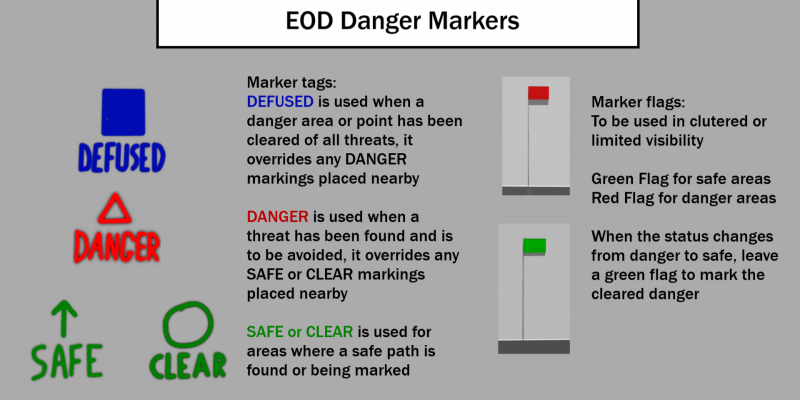
Stencils use text and standardized shapes for rapid recognition. Three color-coded statuses apply:

  • DEFUSED: Indicates the area or device has been cleared of all threats. Overrides any nearby DANGER markings.
  • DANGER: Indicates a confirmed threat. Overrides any SAFE or CLEAR markings in the vicinity.
  • SAFE / CLEAR: Indicates a verified safe path or cleared area.

Markings should be placed clearly and unambiguously to prevent conflicting signals.

Flag Markers
When ground tags are not visible (e.g., tall grass, debris, uneven terrain), use flag markers instead:

  • Red flags: Mark confirmed danger areas.
  • Green flags: Mark safe lanes or cleared areas.

If a danger area marked by a red flag is later cleared, replace or supplement it with a green flag to ensure clarity for follow-on elements.

Placement Standard
Markers must be visible from a distance. Safe lanes should be marked at regular intervals, with each marker visible from the next to create a continuous path. Danger markers should be positioned at eye level when ground visibility is limited to ensure they are not overlooked.

Markings available with the EOD Stencil

Above: Markings available with the EOD Stencil

FM/G156 - Identifying and reacting to explosive devices

FM/BG-1683 - Explosive charges

Explosive charges are primarily used as a tool for demolition or destruction of selected targets. They may also be encountered as a deliberate method for destroying key assets during ambushes or defensive manoeuvres. Explosive charges vary in size, ranging from small charges used to break locks or door hinges to large quantities of explosives rigged to a single detonator for the destruction of structures or equipment.

Explosive charges typically lack secondary elements such as fragmentation and rely mainly on the placement and quantity of explosive used to achieve the desired effect. They are usually activated by a remote detonator, such as a clacker or radio signal, or by a timed detonator.

FM/BG-785 - Anti-personnel (AP) mines

AP devices are small and low-profile, designed to be difficult to notice during normal movement. They are commonly placed at foot level and may appear as compact charges, plates, or concealed objects positioned along likely dismounted routes to deny dismounted movement or shape movement into a kill zone.

AP devices are typically victim-activated. Common trigger mechanisms include pressure activation or proximity-based activation (including trip wires) intended to detonate when infantry moves into the device’s effective area. AP devices are often used in clusters or integrated into broader defensive setups.

FM/BG-1466 - Anti-tank (AT) mines

AT devices are larger than AP devices and positioned to engage vehicles. They may appear as heavy charges, mines, or reinforced objects placed on or near vehicle routes, intersections, or choke points.

AT devices are usually pressure-activated by vehicle weight or remotely initiated. Some may be command-detonated to allow engagement of specific vehicles rather than the first contact. AT mines can generally not be set off by dismounts.

FM/BG-1467 - Improvised explosive devices (IEDs)

IEDs vary widely in size and construction. They may appear as modified objects, containers, ordnance or placed charges that blend into the environment. Their inconsistent appearance makes them difficult to identify without deliberate inspection or the use of a mine detector. IEDs may be integrated into deliberate defensive systems or employed to target predictable movement and are used to reduce morale, delay movement, or disrupt operations..

IEDs may be victim-activated, command-detonated, or time-based. This flexibility allows them to be used against both personnel and vehicles and to be triggered at a chosen moment.

FM/BG-1468 - Unexploded ordnance (UXO)

UXO appears as intact or partially damaged munitions that failed to detonate as intended. These may include shells, rockets, or dropped ordnance and are often visually recognizable as military munitions.

UXO does not have an intended trigger but remains unstable. Detonation may occur due to movement, interaction, or secondary effects, making it unpredictable and hazardous. UXO is commonly encountered in areas subjected to indirect fire or air-delivered munitions and may remain a threat long after initial contact.

FM/BS-1469 - Identify and react to explosive devices

Recognize potential explosive devices and initiate immediate protective actions.

  • Identify suspicious objects, munitions, or placed charges inconsistent with the surrounding environment.
  • Assume live: Treat all suspected Mines or Explosives as armed and hazardous unless marked as safe.
  • Warn others: Clearly announce the hazard to nearby elements.
  • Halt movement: Immediately stop personnel and vehicles in the affected area.
  • Establish standoff: Maintain distance appropriate to the suspected device type.
  • Mark and report: Mark the location if possible and report through the chain of command.
  • Await clearance: Do not disturb or attempt to neutralize unless tasked and equipped to do so.

FM/G157 - Using explosive devices

FM/BS-1773 - Select an explosive method
  • Identify the task (breaching, demolition, disposal)
  • Assess target type and environment
  • Determine if explosives are required or if alternative methods are more suitable
  • Select the method that achieves the objective with acceptable risk
  • Confirm selection supports follow-on actions and overall plan
FM/BG-1759 - Using explosive to destroy equipment

Explosives may be used to destroy vehicles or equipment when recovery is not possible. This typically occurs during sabotage operations, demining, or after capturing enemy positions. Use must be directed by the Chain of Command, either as part of a plan or via direct orders.

Explosive selection should match the target. Heavily armoured or reinforced targets require more powerful charges, while lighter equipment can be neutralised with smaller devices.

Common applications:

  • Incendiary Grenade
    • Destroy ammunition or weapon crates
    • Disable individual weapons
    • Disable light vehicles when applied effectively
  • Demolition Block
    • Destroy light and lightly armoured vehicles
    • Neutralise emplacements (e.g. artillery, SAM systems)
  • Demolition Charge Assembly
    • Destroy multiple heavy vehicles
    • Demolish large infrastructure (e.g. hangars, communication towers)
FM/BS-786 - Place an explosive device

Place an explosive device to ensure effectiveness against one or multiple targets, taking into account those factors :

  • Distance to target(s)
  • Direction of the explosion
  • Protection of the target against the explosive from certain angles
  • Concealment of the device
FM/BS-787 - Arm an explosive device

Arm explosive devices in a way that ensures a safe exit for all personnel in the area and make sure nearby elements are aware of the danger area.

When using a timed trigger, note down and communicate the selected duration and the expected time of detonation.

FM/BS-1775 - Establish a safe blast area
  • Identify expected blast radius based on charge type and environment
  • Clear all personnel and vehicles from the danger area
  • Establish safe standoff positions for all elements
  • Communicate blast area boundaries to nearby elements
  • Monitor the area continuously until detonation
FM/BS-788 - Detonate an explosive device
  • Ensure the danger area is clear of friendlies
  • Announce "Fire in the hole! Fire in the hole! Fire in the hole!" five seconds before detonating
  • Cancel the detonation on any calls or change of the situation that may indicate the area is no longer clear
  • When using a timed trigger, give an additional 1 minute warning before the expected detonation time
FM/BG-1760 - Preparing a breach point

Selecting an effective breach point is critical to maintaining protection and momentum during entry.

The breach location should provide adequate cover for elements preparing to breach. This includes maintaining standoff from the danger area during explosive breaching and using available protection such as trenches, walls, or other terrain features.

An effective breach point should allow for rapid and protected entry into the target area. Prioritise entry points that lead directly to nearby cover or accessible structures to support immediate movement and consolidation.

Avoid creating breaches that open into exposed or highly visible areas, particularly those overlooked from multiple positions, as this can create a kill zone and significantly increase risk to assaulting elements.

FM/BG-1761 - Using explosives for breaching

Explosives may be used to breach rooms, buildings, compounds, or perimeter barriers. Compared to ballistic breaching (e.g. shotgun entry), explosive breaching requires additional planning and setup.

Charge selection should match the target. Consider whether explosives are necessary and, if so, use the minimum force required:

  • Linear charges
    • Suitable for doors and light entry points
    • Provide controlled entry with minimal overpressure
  • Demolition charges / blocks
    • Used for reinforced structures (e.g. metal or concrete walls)
    • Require greater consideration of blast effects and safety

As with all explosive use, ensure actions align with FM/BG-348 - Understanding rules of engagement (ROE) and FM/BS-350 - Minimize collateral damage against civilian infrastructure, particularly during unplanned or dynamic breaching.

FM/G384 - Defensive fortifications

FM/BG-1764 - Defensive fortifications

Defensive fortifications are positions prepared to provide a tactical advantage against attacks from one or more directions. They can be constructed using permanent structures, temporary defences, or improvised materials.

These may include:

  • Permanent structures (e.g. concrete bunkers)
  • Temporary fortifications (e.g. sandbags, weapon emplacements)
  • Improvised cover (e.g. vehicle wrecks, earth trenches)

Terrain should be used to strengthen the position. Elevated ground improves visibility and engagement range, while open ground to the front provides clear fields of fire. In built-up areas, multi-storey structures can be reinforced to create additional protected firing positions.

Fortifications intended for extended use should be developed to improve survivability. This includes:

  • Protecting against flanking approaches
  • Adding rear and overhead cover
  • Dividing positions into separate sections to reduce the impact of indirect fire
FM/BG-1763 - Using different mine types

The type of mine, its trigger, and its effect should match the defensive plan. Using the wrong type in the wrong place limits effectiveness (e.g. anti-tank mines in doorways will not stop infantry movement).

Each type of mine is suited to different roles:

  • Tripwire charges
    • Best used in doorways, corridors, and other funnel points
    • More effective when placed beyond the initial entry point (e.g. second or third choke point), where attention is lower and spacing is tighter
    • Work well in dense terrain (woodland, tall grass) where visibility is limited
  • Anti-personnel (AP) pressure plate
    • Used to engage and disrupt infantry movement
    • Effective in open ground, approaches, and likely foot routes
    • Pressure plate mines work well in areas of expected foot traffic
    • Can be used to cover gaps between obstacles or larger minefields
  • Anti-tank (AT) pressure plate
    • Used to restrict or slow vehicle movement
    • Effective along roads, tracks, and vehicle approaches
    • Can be used to shape movement, forcing vehicles into predictable paths or engagement areas

Different mine types can be combined to increase effectiveness. For example, AT mines can control vehicle movement while AP mines and tripwires cover likely infantry approaches and dismount points.

Mines should always be placed with a clear purpose, supporting the wider defensive layout rather than being used in isolation.

FM/BG-1762 - Using mines for defence

Mines are used to deny areas and control how the enemy moves. How you place them depends on how many you have and what you’re trying to achieve.

There are two main ways to use them:

  • Dense minefields
    • Place mines close together to make moving through the area very difficult
    • Slows the enemy down and forces them to move carefully
  • Targeted placement
    • Place mines along likely routes (roads, gaps, open ground)
    • Push the enemy into worse terrain or away from key areas
    • Force them to spend time clearing or rerouting

Mines work best when combined with other defences. On their own they slow the enemy, but when covered by fire and observation they become much more effective.

For effective use:

  • Place them where you can see the area
  • Cover them with direct or indirect fire
  • Combine them with obstacles like tank traps or barriers

FM/G385 - Ordnance disposal and clearance

FM/BG-1765 - Encountering a minefield

When encountering a suspected or confirmed minefield, quickly assess the likely extent of the hazard area. This may be clearly defined by warning signs, physical barriers, or obvious defensive layouts. In unmarked cases, mine placement may follow terrain features such as forest edges, open ground, or integrated defensive positions.

Once a suspected danger area is identified:

  • Mark the boundary clearly using available markers (flags, tags, or visible indicators)
  • Record and share markings using maps or other navigation tools
  • Avoid disturbing the area unnecessarily

The preferred option is to bypass the minefield entirely. Where movement through the area is required due to terrain or mission constraints, controlled access should be established using a cleared route FM/BG-1766 - Delineating clearing lanes.

FM/BG-1766 - Delineating clearing lanes

When movement through a mined or suspected area is required, it is more effective to clear designated routes (lanes) rather than attempt to remove all hazards.

Lane clearance methods will depend on available equipment, but the following principles apply:

  • Clear only what is needed to support movement
  • Ensure sufficient width:
    • At least twice the width of the largest asset expected to pass
    • Allows for manoeuvre and reduces risk of deviation into uncleared ground
  • Mark lane boundaries clearly:
    • Use visible indicators (flags, markers)
    • Use chemlights or reflective markers in low visibility conditions
  • Maintain clear separation between cleared and uncleared areas

These principles also apply in built-up areas. Any structures within the required lane width should be treated as part of the clearance zone and checked for hazards.

FM/BS-1774 - Clear a lane
  • Identify start and end points for the lane
  • Select route that avoids high-risk areas where possible
  • Use detection equipment to locate hazards along the route
  • Neutralise, mark, or bypass hazards within the required width
  • Maintain consistent alignment and spacing throughout the lane
  • Confirm the lane is safe before authorising movement
FM/BS-1776 - Mark a cleared route
  • Define the limits of the cleared route
  • Place visible markers along both boundaries
  • Maintain consistent spacing ensuring each marker is visible from the next
  • Use appropriate markers for conditions (flags, chemlights, reflectives)
  • Update markings as the route status changes

FM/G161 - Explosive ordnance disposal (EOD) operations

FM/BG-1767 - Working as a defusal team

Explosive detection and disposal should be conducted in pairs to maintain safety and awareness.

Team roles:

Focus role

  • Works closest to the hazard
  • Conducts detection, marking, or defusal

Alert role

  • Maintains situational awareness
  • Prevents others entering the danger area
  • Supports and guides the focus operator

Both members should remain within visual and audible range.

During lane clearing:

  • The focus role leads and handles hazards
  • The alert role maintains spacing, marks the cleared route, and monitors for threats

If contact occurs, stop work immediately and withdraw together.

When attached to larger elements, EOD personnel should operate under cover or overwatch.

FM/BS-811 - Use a mine detector
  • Open the mine detector panel
  • Activate the mine detector
  • While walking, cover the entire area by sweeping the mine detector over every object
FM/BS-812 - Disarm an explosive device
  • Ensure the surrounding area is cleared in case the explosive device detonates
  • Disarm the explosive device using a defusal kit or another specialized tool (IEDD Only)
  • Recover the disarmed explosive device
FM/BS-813 - Dispose an explosive device by detonating it
  • Use remote detonation of explosives only when it is the most effective solution and fits within
    ROE.
  • Ensure the surrounding area is cleared so that the explosive device can detonate without causing injuries or property damage
  • Detonate the explosive device by either:
    • Planting a small charge next to it and detonating it
    • Shooting it
FM/BS-814 - Mark safe and danger areas
  • Use a red diamond to mark a danger area
  • Use a green cross to mark a safe area
  • Apply a green cross or diamond to over a red cross or diamond after the area it marked as dangerous has been made safe
  • Update markers as the area's status changes

FM/G386 - Ordnance disposal using the improvised explosive devices defusal (IEDD) notebook

FM/BG-1769 - GM guidance for using IEDD devices

IEDD devices are more complex than standard IEDs and can impact performance. Their use should be controlled to maintain a stable and playable environment.

General considerations:

  • Limit the number of active IEDD devices to fewer than 10 at any time
  • Use them alongside standard IEDs to balance variety and pacing
  • Be aware that they require more time for setup and player interaction

Key parameters to manage:

  • Variant X
    • Non-defusable and not identifiable by players
    • Should not be used in standard gameplay scenarios
  • Explosion size
    • The effective wound radius may be significantly larger than the visible blast
    • Capable of damaging vehicles and structures
  • Activation radius
    • Defines the trigger distance
    • Large radii (greater than ~4m) can be difficult to manage, especially in urban environments with limited visibility

IEDD devices should be used deliberately, with consideration given to performance, gameplay balance, and player experience.

FM/BG-1768 - Using the notebook

The IEDD notebook provides essential information to help identify and disarm improvised explosive devices. It is a reference tool, not a step-by-step solution, and requires the user to apply judgement and reasoning to determine the correct approach.

Defusers are expected to:

  • Use the notebook to support identification of device types
  • Apply logic and observation to determine safe actions
  • Avoid relying solely on the notebook without understanding the situation

FM/G387 - Additional EOD equipment

FM/BG-1770 - Demining UGV [ED-1D]

The ED-1D is a ground drone used to remotely detonate explosive devices using dedicated ammunition.

When operating the UGV:

  • Maintain safe distance to reduce the risk of damage from detonations
  • Be aware of the surrounding area before engaging targets

The platform includes a built-in mine detector with a range of up to 50m.

FM/BG-1771 - Demining UAS

The demining UAV is a flying platform used to detonate explosive devices from above.

When employing the UAV:

  • Account for movement and momentum, as munitions follow the drone’s motion
  • Use hovering for more precise targeting when required

The platform includes a built-in mine detector with a range of up to 50m.

FM/BG-1772 - Lane clearing vehicles

The lane-clearing vehicles, such as the Stryker, use a mine plough to trigger and clear explosive hazards.

When operating the vehicle:

  • Enable and lower the mine plough before advancing
  • Expect reduced mobility, especially on uneven terrain
  • Adjust movement to avoid becoming immobilised

For safe and effective use:

  • Limit speed to approximately 15 km/h to reduce vehicle damage from detonations
  • Use the lane marking system to define a cleared route
    • Markers deploy from the rear of the vehicle
    • Use consistent spacing (e.g. ~25m intervals)

Be aware that markers are physical objects and may be affected by terrain or vehicle movement.

Back to
No Previous Chapter
Forward to
No Next Chapter
This page generated 1.82MB in 0.1635 seconds.